
By Joseph A. Spiriti Jr., Esq.
Caserta & Spiriti, PLLC
Imagine coming home after a long day at work only to find water leaking through your ceiling, mold spreading behind your bathroom vanity, or roaches appearing in your kitchen despite repeated complaints to your landlord.
Like most tenants, your first instinct may be to pick up the phone, send a text message, or assume someone will eventually come out and fix the problem.
Sometimes they do.
Unfortunately, many times they don’t.
Mold: The Mold May Not Be the Real Legal Issue
One of the most common questions I receive is:
“Can I break my lease because there’s mold?”
The answer depends on several factors.
Interestingly, Florida’s Residential Landlord and Tenant Act does not specifically mention mold.
Instead, the legal analysis often focuses on what is causing the mold.
For example:
- Is there a leaking roof?
- A broken plumbing line?
- Water intrusion around windows?
- An air conditioning system creating excessive moisture?
- A leak inside a wall that has gone unrepaired?
In many situations, the underlying water intrusion—not simply the visible mold itself—is what creates the legal issue.
That’s why I encourage tenants to describe the actual conditions in their written notice.
Don’t simply write:
“There’s mold.”
Instead, explain:
- where the mold is located;
- when you first noticed it;
- whether it appears to be spreading;
- whether water is actively leaking; and
- what damage has occurred.
Specific facts help create a much clearer picture than general complaints.
Attorney’s Tip
If you’re considering making a claim involving mold, resist the urge to immediately throw away damaged items or begin extensive cleanup before documenting the condition.
Good photographs taken early often become some of the strongest evidence available later.
Roaches, Termites & Other Pest Problems
Nobody rents a home expecting to deal with cockroaches, termites, rats, or other pests.
Fortunately, Florida law generally places responsibility on landlords of many apartment and multi-family properties to make reasonable provisions for extermination of certain pests and wood-destroying organisms unless the responsibility has been lawfully modified in writing.
If extermination requires tenants to temporarily leave the property, Florida law also contains provisions governing notice, temporary relocation, and rent abatement in certain situations.
That said, one of the biggest mistakes I see is tenants assuming those same rules automatically apply to every rental home.
They don’t.
If you’re renting a single-family residence or duplex, the lease may allocate responsibilities differently.
Never assume.
Always verify.
Plumbing Leaks, Sewage Problems & Loss of Hot Water
Some maintenance issues are inconvenient.
Others become more serious with each passing day.
Water leaking behind walls can lead to structural damage.
Sewage backups may present sanitation concerns.
A lack of running water or hot water can substantially affect everyday living.
Florida law generally requires landlords to maintain plumbing in reasonable working condition and, in many apartment settings, provide running water and hot water as required by law.
The sooner these conditions are documented and reported in writing, the easier it often becomes to establish a clear timeline of events.
Waiting several weeks while hoping the problem resolves itself rarely helps anyone.
The One Document That Can Make—or Break—Your Case
If you’ve read this far, you’ve already learned about documenting problems, reviewing your lease, and putting concerns in writing.
Now let’s talk about what I believe is often the single most important document in a Florida landlord-tenant dispute.
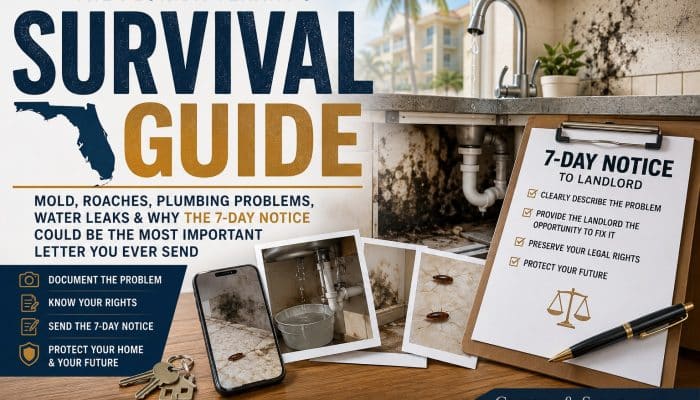
The 7-Day Notice.
Many people think it’s simply another complaint letter.
It isn’t.
It is the statutory notice recognized by Florida law that often serves as the legal foundation for preserving a tenant’s rights while providing the landlord with the notice and opportunity to cure contemplated by law before certain legal remedies become available.
In my experience, judges frequently look at this document early in a case because it often tells the story of what happened, what the tenant complained about, and whether the landlord was given a fair opportunity to correct the problem.
Unfortunately, I’ve also seen otherwise legitimate claims become much more difficult because the notice contained avoidable mistakes.
Some of the most common include:
- Sending the notice to the wrong person.
- Failing to clearly describe the conditions.
- Demanding relief not authorized under the circumstances.
- Omitting important facts.
- Using generic internet forms that don’t fit the situation.
- Delivering the notice improperly.
- Waiting too long to send it.
Each of these mistakes can affect the case.
Although Florida law generally does not require an attorney to prepare a 7-Day Notice, I strongly recommend having an experienced Florida landlord-tenant attorney prepare or review it whenever practical.
Not because attorneys have a “special form,” but because experience matters.
A properly prepared notice helps preserve important legal rights, clearly identifies the issues requiring repair, documents the landlord’s opportunity to cure, establishes a timeline of events, and may become one of the most important pieces of evidence if litigation later becomes necessary.
Simply put, the 7-Day Notice is much more than a letter.
It is often the document that lays the legal foundation for everything that follows.
What Should Be Included in a Florida 7-Day Notice?
No two landlord-tenant disputes are exactly alike. The facts, the lease, and the nature of the problem all matter. That’s why there is no “one-size-fits-all” notice that works in every situation.
Generally speaking, however, a properly prepared 7-Day Notice should clearly identify:
- The tenant’s name and rental property address.
- The date the notice is prepared.
- The landlord or property manager receiving the notice.
- A detailed description of each condition requiring attention.
- When the problem first began, if known.
- Any damage or health or safety concerns that have resulted.
- A clear request that the landlord correct the condition within the time allowed by law.
- When appropriate, the statutory remedy the tenant intends to pursue if the condition is not timely corrected.
One of the biggest mistakes I see is tenants relying on vague statements such as:
“The apartment is terrible.”
That tells the landlord—and, if litigation later becomes necessary, the court—very little.
A much stronger notice identifies the specific issues. For example:
- Water is leaking beneath the kitchen sink and has damaged the cabinet flooring.
- Mold has developed behind the bathroom vanity following an unrepaired plumbing leak.
- The water heater has not produced hot water since a specific date.
- Roaches continue to appear throughout the kitchen despite previous extermination efforts.
Specific facts are almost always more persuasive than general complaints.
Attorney’s Tip
Think of your notice as a professional business letter—not an emotional social media post.
Avoid exaggeration.
Avoid insults.
Avoid assumptions.
State the facts accurately, calmly, and completely. Credibility is one of your greatest assets if the matter later finds its way into a courtroom.
Before You Decide to Withhold Rent
Perhaps no subject creates more confusion than rent withholding.
I’ve had many clients tell me,
“My landlord hasn’t fixed anything, so I’m just going to stop paying rent.”
That decision can create serious legal consequences if the statutory procedures have not been followed.
Florida law provides certain remedies when a landlord materially fails to comply with legal obligations. However, those remedies generally depend upon proper notice being given and the applicable statutory requirements being satisfied. If litigation occurs, tenants may also be required to deposit rent into the court registry while the dispute is pending.
For that reason, I strongly encourage tenants not to withhold rent, terminate a lease, or move out without first understanding their legal rights and obligations.
The cost of making the wrong decision can far exceed the cost of obtaining legal advice beforehand.
When Your Landlord Doesn’t Follow the Rules
The vast majority of landlords want satisfied tenants and make reasonable efforts to address legitimate maintenance concerns.
Occasionally, however, disputes escalate.
If a landlord attempts to force a tenant out by changing the locks, disconnecting utilities, removing doors, or otherwise preventing access to the property without following Florida’s legal eviction process, the situation becomes much more serious.
Florida law generally prohibits these types of “self-help” eviction practices.
If something like this occurs, don’t simply argue with the landlord.
Document everything.
Preserve photographs, videos, emails, text messages, and any witness information.
Then speak with an experienced Florida landlord-tenant attorney as soon as practical to determine your legal options.
Eight Common Mistakes That Can Hurt an Otherwise Good Case
Over the years, I’ve seen many disputes become far more complicated because of mistakes that could have been avoided.
Some of the most common include:
-
Waiting too long to report the problem.
Small maintenance issues rarely improve by themselves.
-
Complaining only by phone.
Verbal conversations are difficult to prove later.
-
Throwing away damaged property before documenting it.
Always preserve evidence whenever practical.
-
Sending an incomplete or vague notice.
General complaints rarely tell the full story.
-
Assuming every maintenance problem creates the same legal remedy.
Different conditions may involve different legal rights.
-
Ignoring the lease agreement.
Many answers are found there.
-
Downloading generic internet forms.
A notice that worked for someone else’s situation may not be appropriate for yours.
-
Acting out of frustration instead of strategy.
Emotions are understandable.
Good documentation and careful preparation usually produce better results.
Frequently Asked Questions
Can mold allow me to break my lease?
Possibly—but not automatically.
Whether a tenant may terminate a lease depends upon numerous factors, including the cause of the condition, whether the landlord materially failed to comply with applicable legal obligations, the language of the lease, and whether proper statutory notice was provided.
Every situation should be evaluated on its own facts.
Can I withhold rent because of roaches or plumbing problems?
Don’t assume you can.
Florida law establishes procedures that generally require proper written notice before certain remedies become available. Depending upon the circumstances, additional legal requirements may also apply.
If you’re considering withholding rent, speak with an experienced Florida landlord-tenant attorney first.
What if my landlord ignores my written notice?
The answer depends on the facts, the lease, the applicable statutes, and the specific condition involved.
If the required notice was properly prepared and delivered, additional legal remedies may become available depending upon the circumstances. An attorney can help evaluate those options.
Is an attorney required to prepare a 7-Day Notice?
No.
Florida law generally does not require an attorney to prepare the notice.
However, because the 7-Day Notice frequently becomes one of the most important documents in a landlord-tenant dispute, I strongly recommend having an experienced Florida landlord-tenant attorney prepare or review it whenever practical.
The notice is more than a letter. It is often the document that preserves rights, satisfies statutory notice requirements, provides the landlord with the opportunity to cure contemplated by law, and helps establish the foundation for any future legal action.
Getting it right the first time is almost always preferable to trying to correct mistakes after litigation begins.
Does every maintenance problem give me the right to terminate my lease?
No.
Florida law does not treat every maintenance issue the same way.
The severity of the condition, the lease agreement, the applicable statutes, and the facts surrounding the dispute all play important roles in determining what remedies, if any, may be available.
Final Thoughts
After more than three decades practicing landlord-tenant law throughout Florida, I’ve learned that most cases aren’t won or lost because someone had a stronger argument.
They’re won or lost because someone preserved—or failed to preserve—their rights from the very beginning.
The law gives landlords important rights.
It gives tenants important rights as well.
But it also requires both sides to follow certain procedures before asking a court to intervene.
If you’re dealing with mold, termites, roaches, plumbing failures, sewage backups, water intrusion, loss of hot water, or other serious maintenance concerns, don’t rely solely on phone calls or generic forms you find online.
Take photographs.
Keep detailed records.
Review your lease.
Communicate in writing.
And never underestimate the importance of a properly prepared 7-Day Notice.
Although an attorney is generally not required to prepare that notice, it is often the legal foundation upon which the rest of the case is built. A properly prepared notice not only helps preserve important legal rights, but also provides the landlord with the notice and opportunity to cure contemplated by Florida law before certain remedies may become available.
As I often tell my clients, it’s almost always easier—and far less expensive—to protect your rights at the beginning of a case than it is to repair avoidable mistakes after a dispute has escalated.
If you’re uncertain about your rights or how Florida law applies to your specific situation, consult with an experienced Florida landlord-tenant attorney before making decisions that could affect your legal remedies.
About the Author
Joseph A. Spiriti Jr., Esq. is a Florida attorney and partner with Caserta & Spiriti, PLLC, where he has represented landlords, tenants, homeowners, businesses, and property owners in a wide variety of Florida real estate and landlord-tenant matters for more than 30 years.
This article is provided for general educational purposes only and is not intended as legal advice. Reading this article does not create an attorney-client relationship. Every landlord-tenant matter depends upon its unique facts, the terms of the lease, and the notices exchanged between the parties. Individuals should consult with a qualified Florida attorney regarding their specific circumstances.