
Author: Robert L. Mellinger, Esq.

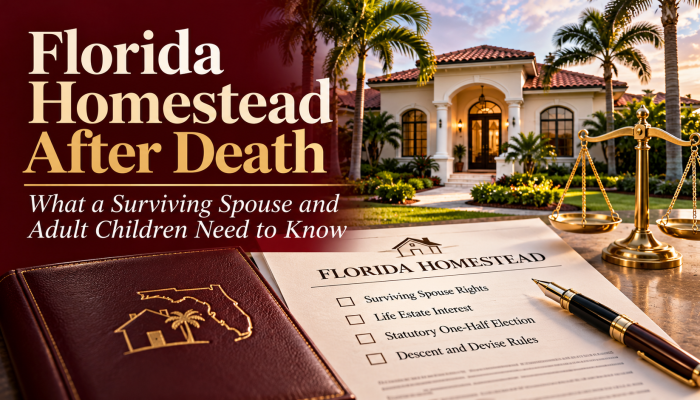
Florida Homestead After Death

What a Surviving Spouse and Adult Children Need to Know

Written by Robert Mellinger, Esq.

Florida homestead law can produce results that surprise families after a homeowner dies. A Will may say one thing, a deed may suggest another, and family members may assume that a surviving spouse automatically becomes the sole owner of the home. Florida law, however, gives homestead property special constitutional and statutory treatment.

When a Florida homeowner dies leaving a surviving spouse, descendants, or both, the first questions should include whether the property was the decedent’s protected homestead, how title was held, whether the homestead was validly devised, and whether a surviving spouse has an election that must be exercised within a statutory deadline.

KEY TAKEAWAY

A Florida Will does not necessarily control homestead the same way it controls ordinary probate property. If homestead is not devised as Florida law and the Constitution permit, and the decedent leaves a spouse and descendants, the surviving spouse generally receives a life estate and the descendants receive the vested remainder. The spouse may instead elect an undivided one-half interest as a tenant in common-but the election generally must be made within six months after death and during the spouse’s lifetime.

Why Florida Homestead Is Different

Florida’s homestead protections are not merely tax rules. Homestead can affect creditor protection, restrictions on devise, and the ownership interests that arise at death. Chapter 732 of the 2026 Florida Statutes contains specific rules governing descent and devise of protected homestead.

That is why an estate plan should not analyze the Last Will & Testament in isolation. The deed, marital status, descendants, constitutional homestead status, Trusts, and other ownership arrangements can all matter.

When a Homestead Cannot Be Freely Devised

Florida Statute § 732.4015 reflects the constitutional restriction on devise. If the owner is survived by a spouse or minor child, the homestead is not freely devisable, except that the homestead may be devised to the owner’s spouse when there is no minor child.

The statute also recognizes that a disposition through certain Trusts can constitute a “devise” for homestead purposes. Moving a residence into a Trust therefore does not automatically eliminate Florida’s homestead restrictions.

What Happens When the Decedent Leaves a Spouse and Descendants?

Under § 732.401, when protected homestead is not devised as authorized by law and the Constitution, and the decedent is survived by a spouse and one or more descendants, the surviving spouse takes a life estate in the homestead. The decedent’s descendants in being at death receive the vested remainder per stirpes.

A life estate and a remainder interest divide ownership over time. The surviving spouse has the present life estate interest, while the descendants hold the future remainder. That structure can create practical questions involving possession, repairs, insurance, taxes, improvements, sale, and allocation of expenses.

The Surviving Spouse Has an Important Alternative

Florida law gives the surviving spouse an alternative to the statutory life estate. Instead of taking the life estate, the spouse may elect an undivided one-half interest in the homestead as a tenant in common. The remaining undivided one-half interest then vests in the decedent’s descendants in being at death, per stirpes.

This can materially change the family’s ownership structure. A life tenant and remaindermen have different rights and economic interests from co-owners holding undivided tenant-in-common interests.

The Six-Month Deadline Is Critical

The homestead election is time-sensitive. Section 732.401 provides that the election generally must be made within six months after the decedent’s death and during the surviving spouse’s lifetime. Once made, the election is irrevocable.

The statute requires the election to be made by recording a notice of election containing the legal description of the homestead in the official records of the county or counties where the property is located. Special rules apply when an attorney in fact or guardian seeks court approval to make the election for the surviving spouse.

Families should therefore obtain advice promptly after death rather than waiting until the probate estate is close to completion.

How Are Property Expenses Handled?

Until a one-half tenant-in-common election is made, § 732.401 directs that expenses relating to ownership of the homestead be allocated between the surviving spouse as life tenant and the descendants as remaindermen under Chapter 738. If the spouse makes the election, ownership expenses are allocated between the spouse and descendants as tenants in common in proportion to their shares, effective as of the filing of the election.

This is one reason families should avoid informal assumptions about who “owns the house” or who must pay every expense after death.

Title Can Change the Analysis

Section 732.401 expressly does not apply to property the decedent owned in tenancy by the entireties or in joint tenancy with rights of survivorship. Those forms of ownership can carry survivorship consequences independent of the descent rule discussed above.

The exact deed should therefore be reviewed before anyone concludes that the residence must pass through the homestead descent framework.

Homestead and the Elective Share Are Separate Concepts

Florida also protects a surviving spouse through the elective-share statutes. Under § 732.2065, the elective share is 30 percent of the elective estate. The elective estate can include more than the traditional probate estate; § 732.2035 identifies categories that can enter into the elective-estate calculation, including the decedent’s interest in protected homestead.

At the same time, § 732.2105 provides that the elective share is in addition to homestead, exempt property, and statutory allowances. These provisions are technical and should not be reduced to the assumption that a spouse simply receives “30 percent of probate.”

Elective-Share Deadlines Also Matter

The elective share has its own deadline structure. Section 732.2135 generally requires the election to be filed by the earlier of six months after service of the notice of administration on the surviving spouse (or the specified representative) or two years after the decedent’s death, subject to the statute’s provisions concerning extensions and related proceedings.

This deadline is distinct from the six-month homestead election under § 732.401. A surviving spouse may therefore have multiple rights requiring separate analysis and separate action.

What If There Is No Valid Homestead Devise?

If homestead is not devised as authorized, the statutory descent rules apply. The consequences depend on who survives the decedent and how title was held. Where a spouse and descendants survive, the life estate/remainder structure and the spouse’s one-half election become central.

Where the family structure is different, the result can be different. This is why a deed, Will, Trust, marital history, and family tree should be reviewed together.

Adult Children Should Not Assume They Can Force Immediate Control

When descendants receive vested remainder interests subject to a surviving spouse’s life estate, their ownership interest is real, but it is not the same as the spouse’s present possessory life estate interest. Conversely, a surviving spouse should not assume that a life estate is equivalent to sole fee-simple ownership.

When the spouse elects a one-half tenant-in-common interest, the legal relationship changes again. Families considering sale, refinancing, major repairs, or settlement should identify the actual interests before signing documents or making commitments.

Estate Planning Before Death Can Prevent Confusion

Homestead planning is especially important in second marriages, blended families, families with minor children, and situations where the homeowner wants a spouse to remain in the residence while ultimately preserving an interest for descendants.

A Will, Trust, deed, beneficiary plan, marital agreement, and Power of Attorney should be coordinated rather than drafted as unrelated documents. A plan that appears straightforward for ordinary assets may operate very differently when the asset is Florida protected homestead.

Practical Checklist After a Florida Homeowner Dies

Before deciding who owns the residence or how it should be handled, obtain and review the current deed; determine whether the property qualified as the decedent’s homestead; identify the surviving spouse and descendants, including whether any child is a minor; review the Will and any relevant Trust; determine whether the property was held with survivorship rights; calendar the surviving spouse’s six-month homestead election deadline when applicable; evaluate any elective-share rights and deadlines separately; and avoid selling, transferring, or encumbering the property until the ownership interests are understood.

The Bottom Line

Florida homestead is one of the areas where a seemingly simple estate can become legally complicated very quickly. The home may be subject to constitutional restrictions on devise, statutory descent rules, a surviving spouse’s election, and separate elective-share rights.

For surviving spouses and adult children, early analysis can prevent missed deadlines and misunderstandings about ownership. For homeowners planning ahead, coordinating the deed and estate-planning documents can reduce the risk of an unintended result.

At Caserta & Spiriti, PLLC, we assist Florida families with elder law, probate, estate planning, deeds, homestead issues, and related real estate matters.


Disclaimer: This article is provided for general informational and educational purposes only and is not legal advice. Reading this article or receiving this e-mail does not create an attorney-client relationship. Florida homestead and probate rights are highly fact-specific and may depend on the deed, family circumstances, estate-planning documents, and timing.

Elder Law in Florida: Planning for Long-Term Care, Medicaid, Guardianship & Aging

As we age, legal and financial issues can become just as important as medical concerns. Florida Elder Law focuses on helping older adults and their families address issues such as long-term care, Medicaid planning, Estate Planning, Powers of Attorney, health care decisions, Guardianship, elder abuse, and financial exploitation.

The goal is not simply to plan for what happens after death. Elder law planning also addresses what happens if you need help managing your health, finances, or daily life while you are still living.

What Is Elder Law in Florida?

Elder Law is a broad area of legal practice involving issues that commonly affect seniors and their families. Depending on the circumstances, Elder Law planning may involve:

  • Wills and Trusts;
  • Durable Powers of Attorney;
  • Healthcare Surrogate Designations and Living Wills;
  • Long-term care planning;
  • Medicaid eligibility and planning;
  • Nursing home and assisted-living issues;
  • Guardianship and alternatives to Guardianship;
  • Asset protection planning;
  • Elder abuse and financial exploitation;
  • Veterans benefits;
  • Probate and estate administration; and
  • Planning for incapacity and changing care needs.

Because every family’s financial, medical, and family circumstances are different, there is no single Elder Law plan that works for everyone.

Why Is Long-Term Care Planning Important?

One of the most significant challenges facing older adults is paying for long-term care.

Long-term care may be provided at home, in an assisted-living setting, or in a nursing facility. It may include assistance with activities of daily living such as bathing, dressing, eating, and medication management.

A common misconception is that Medicare will pay for a person’s long-term nursing home care. Generally, it does not. Medicare may cover certain medically necessary, short-term skilled nursing facility services when specific requirements are satisfied, but it generally does not cover custodial long-term care simply because a person needs ongoing assistance with daily activities.

That distinction can have significant financial consequences.

Families should consider their potential sources of payment, which may include:

  • Personal income and assets;
  • Long-term care insurance;
  • Medicare for services it actually covers;
  • Medicaid, if eligibility requirements are satisfied;
  • Veterans benefits, when applicable; and
  • Other available public or private benefits.

Long-term care planning is generally more effective when it begins before a crisis occurs.

Medicare vs. Medicaid: What Is the Difference?

Medicare and Medicaid are different programs serving different purposes.

Medicare is federal health insurance primarily associated with people age 65 and older and certain individuals with disabilities. It can cover hospital care, physician services and certain skilled nursing or rehabilitation services.

Medicaid is a joint federal-state program that can provide health coverage to people who meet applicable financial and other eligibility requirements. Florida also has Medicaid programs specifically addressing long-term care.

For Florida’s Medicaid long-term care program, eligibility involves more than simply having limited income or assets. Among other requirements, an individual generally must meet applicable age or disability criteria and be determined through Florida’s assessment process to require the level of care specified by law.

Florida’s long-term care Medicaid program can cover services provided in nursing facilities as well as certain home and community-based services through the state’s managed-care system.

Because Medicaid eligibility rules can involve income, assets, transfers, marital status, medical needs and other factors, families should obtain individualized advice before transferring or giving away assets.

Can Medicaid Planning Protect Assets?

Potentially-but Medicaid planning must be done carefully.

Long-term care expenses can significantly affect a family’s financial security. Depending on the circumstances, advance planning may help a family understand whether assets can be preserved while still qualifying for benefits in the future.

However, there is no universal strategy that guarantees Medicaid eligibility or protects every asset.

Transactions involving gifts, transfers, Trusts, real estate, or other assets can have significant legal and Medicaid consequences. Planning should therefore be based on the individual’s circumstances and the applicable rules before assets are transferred, rather than after a nursing home crisis has already occurred.

What Estate Planning Documents Should Seniors Have?

A Florida estate plan should address more than the distribution of property at death.

Depending on the person’s circumstances, important documents may include:

Durable Power of Attorney. Allows an agent to handle financial and legal matters within the authority granted by the document.

Designation of Healthcare Surrogate. Identifies a person who may make health care decisions as authorized under Florida law when the individual cannot make those decisions.

Living Will. Expresses an individual’s wishes concerning life-prolonging procedures in circumstances covered by Florida law.

Last Will & Testament. Directs the disposition of property at death and can nominate individuals to serve in appropriate fiduciary roles.

Trust. In appropriate circumstances, a Trust may provide additional planning for asset management, incapacity, or distribution after death.

These documents should be coordinated rather than prepared in isolation. An estate plan that does not address incapacity may leave a family facing unnecessary difficulty when a person can no longer manage financial or health care decisions.

When Is Guardianship Necessary in Florida?

A Florida Guardianship may become necessary when an adult is unable to exercise some or all of his or her rights and existing planning documents or other less restrictive alternatives are inadequate.

Florida law provides procedures for determining incapacity and appointing a Guardian. Guardians have fiduciary responsibilities and may exercise only those rights that have been removed from the individual and delegated to the Guardian.

Guardianship is an important legal proceeding and should not automatically be viewed as the first solution.

Before pursuing Guardianship, families should determine whether an existing Durable Power of Attorney, Healthcare Designation, Trust, or another less restrictive planning arrangement can address the situation.

Planning while a person still has the legal capacity to make decisions can provide more options later.

What About Senior Housing and Assisted Living?

Aging does not necessarily mean moving into a nursing home.

Depending on a person’s health, finances and preferences, options may include:

  • Remaining at home with family or professional caregivers;
  • Home health or other supportive services;
  • Independent senior living;
  • Assisted living;
  • Memory-care communities;
  • Rehabilitation or skilled nursing facilities; or
  • Other community-based care arrangements.

The right choice depends on the individual’s care needs, safety, financial resources, and personal preferences.

Families should consider these issues before a medical crisis forces an immediate decision. A care manager, social worker, medical professional, or other qualified professional may also help a family evaluate practical care options.

Florida’s Department of Elderly Affairs administers and coordinates numerous programs and services for older Floridians, including long-term-care-related programs and the State Long-Term Care Ombudsman Program.

How Can Families Protect Against Elder Abuse and Financial Exploitation?

Elder Law also involves protecting vulnerable adults.

Florida law specifically addresses abuse, neglect and exploitation of elderly persons and disabled adults. Florida Statute § 825.103 addresses exploitation involving the improper use of an elderly person’s or disabled adult’s funds, assets, or property, including certain misconduct by persons in positions of trust and confidence and certain breaches of fiduciary duty by agents under Powers of Attorney, Guardians, and individual Trustees.

Warning signs can include:

  • Unexplained withdrawals or transfers;
  • Sudden changes to estate-planning documents;
  • Unusual financial gifts;
  • New or unexplained caregivers or “friends” controlling finances;
  • Missing property or valuables;
  • Isolation from family members; or
  • An agent, caregiver or family member refusing to provide financial information.

When exploitation or abuse is suspected, prompt action may be important. Depending on the circumstances, legal remedies, protective proceedings, or other interventions may be available.

When Should a Florida Family Talk to an Elder Law Attorney?

Families often wait until a parent enters a hospital or nursing facility before seeking legal advice. By then, some planning opportunities may be limited.

Consider obtaining legal advice when:

  • A parent is beginning to need significant assistance;
  • Nursing home or assisted-living care is being considered;
  • The family is concerned about how long-term care will be paid for;
  • Medicaid eligibility may become an issue;
  • A parent has significant assets that need to be reviewed;
  • Existing Estate Planning documents are outdated;
  • Someone is beginning to have difficulty managing finances or health care;
  • Family members disagree about care or finances;
  • Guardianship is being considered; or
  • Elder abuse or financial exploitation is suspected.

The earlier a family understands its options, the more opportunity there may be to make informed decisions.

Frequently Asked Questions About Florida Elder Law

What does an Elder Law attorney do in Florida?

An Elder Law attorney helps individuals and families address legal issues associated with aging, including Estate Planning, incapacity planning, long-term care planning, Medicaid, Guardianship, and protection against exploitation.

Does Medicare pay for nursing home care in Florida?

Medicare may cover certain short-term skilled nursing facility services when its requirements are met, but it generally does not pay for ongoing custodial long-term nursing home care.

Does Medicaid pay for nursing home care in Florida?

Florida Medicaid can provide long-term care services to individuals who satisfy applicable eligibility and care requirements. Eligibility should be evaluated on an individual basis.

Can I protect my home from nursing home costs?

The answer depends on the circumstances, including how the property is owned, whether it qualifies as homestead, the individual’s marital and family situation, and applicable Medicaid rules. Do not transfer your home or other assets solely to qualify for Medicaid without first obtaining appropriate legal advice.

Is Guardianship always necessary if a person becomes incapacitated?

No. Florida law recognizes Guardianship as a legal process, but existing Powers of Attorney, health care documents, Trusts, and other arrangements may provide alternatives or reduce the need for court involvement in appropriate circumstances.

Planning for Aging Is About More Than Estate Distribution

Elder law planning is not simply about deciding who receives your property after you die. It is also about planning for the years before death, including who can make decisions, where care will be provided, how that care may be paid for, and how family members can protect a loved one’s dignity and financial interests.

At Caserta & Spiriti, PLLC in Miami Lakes, Florida, we assist individuals and families with Florida estate planning, long-term care planning, Medicaid-related planning, powers of attorney, guardianship matters and other legal issues affecting seniors and their families.

If you or a loved one is beginning to face questions about long-term care, Medicaid, incapacity, guardianship or aging in Florida, obtaining legal advice before a crisis may help you better understand the available options.

Disclaimer: This article is provided for general informational and educational purposes only and is not intended to constitute legal advice. It does not create an attorney-client relationship. Medicaid, Medicare, Guardianship, and long-term care rules are fact-specific and subject to change. The information in this article should not be relied upon as a substitute for advice concerning your particular circumstances.

Elder Financial Exploitation in Florida: Recognizing the Warning Signs and Protecting a Loved One

[What Families Should Know About Financial Abuse, Powers of Attorney, Guardianship, and Estate Planning]

As people live longer, protecting older adults from abuse, neglect, and financial exploitation has become increasingly important. Elder financial exploitation can happen to anyone, regardless of wealth, and the person responsible is sometimes someone the victim knows and trusts.

Florida law specifically addresses the exploitation of elderly persons and disabled adults. Financial exploitation can involve the unauthorized use of money, bank accounts, real estate, or other property. It can also involve abuse of a position of trust, including misuse of a Power of Attorney, Guardianship, or certain fiduciary relationships.

Recognizing the warning signs early can make an important difference.

What Is Elder Financial Exploitation?

Under Florida law, exploitation can include knowingly obtaining or using an elderly or disabled person’s funds, assets, or property with the intent to deprive that person of its use or benefit, or to benefit someone else improperly. Florida law also addresses certain breaches of fiduciary duty by Guardians, Trustees, and Agents acting under a Power of Attorney.

Examples may include:

  • Unauthorized withdrawals or transfers from bank accounts;
  • Misuse of a Durable Power of Attorney;
  • Unexplained changes in property ownership;
  • Improper gifts or loans;
  • Pressure to change a Last Will & Testament, Trust, or Beneficiary Designation;
  • Unauthorized use of credit cards or financial accounts;
  • Selling or transferring property for less than appropriate value; or
  • Using an older adult’s money for someone else’s benefit.

Not every unusual transaction is necessarily exploitation. Circumstances, intent, authority, capacity, and the surrounding facts matter.

Warning Signs Families Should Watch For

Financial exploitation can be difficult to recognize, particularly when an older adult is isolated or embarrassed about what has happened.

Warning signs may include:

  • Sudden isolation from family and friends;
  • Fearfulness around a caregiver, companion, or family member;
  • Unexplained changes in spending or financial circumstances;
  • Unusual bank withdrawals, transfers, or checks;
  • Unpaid bills despite adequate financial resources;
  • Sudden changes in beneficiaries;
  • A new Last Will or Trust that substantially changes a previously established estate plan;
  • Pressure to sign a Power of Attorney or other legal document;
  • Attempts to transfer a home or other valuable property;
  • A new “friend” or caregiver who suddenly becomes financially involved; or
  • An older adult appearing unable or afraid to make independent financial decisions.

A single warning sign does not establish abuse. However, several unexplained changes occurring together deserve attention.

Powers of Attorney Require Special Care

A Florida Durable Power of Attorney can be an extremely useful estate-planning tool. It allows a Principal to authorize an Agent to act on the Principal’s behalf.

However, a Power of Attorney also creates the potential for abuse if an Agent exceeds the authority granted or uses the Principal’s property improperly.

Florida law specifically addresses certain unauthorized appropriations, transfers, sales, and improper benefits involving Agents under a Power of Attorney.

For this reason, a Power of Attorney should be prepared carefully and reviewed periodically-particularly when an older adult’s financial circumstances or family relationships change.

What About Changes to a Last Will or Trust?

Financial exploitation is not limited to bank accounts.

Florida law also addresses certain intentional modifications, alterations, or fraudulent creation of a person’s estate-distribution plan, including a Last Will & Testament or Trust, when the statutory requirements for authorization have not been satisfied.

If an older family member suddenly changes a Last Will, Trust, Beneficiary Designation, or ownership of valuable property under suspicious circumstances, it may be appropriate to have the situation reviewed promptly by a qualified Florida attorney.

What Should You Do If You Suspect Exploitation?

Act promptly-but carefully.

If there is an immediate threat of physical harm, call 911 or contact local law enforcement.

Florida’s Department of Children and Families operates the Florida Abuse Hotline, which accepts reports of suspected abuse, neglect, abandonment, and exploitation of vulnerable adults 24 hours a day, seven days a week. The statewide number is 1-800-962-2873 (1-800-96-ABUSE).

Depending on the circumstances, families may also need to:

  • Preserve bank statements and financial records;
  • Document suspicious transactions and communications;
  • Contact financial institutions;
  • Protect important legal and financial documents;
  • Consult an attorney promptly; and
  • Consider whether court intervention or other legal remedies are appropriate.

Do not confront a suspected exploiter in a way that could place the older adult at greater risk.

Florida Provides a Potential Legal Remedy for Imminent Exploitation

Florida law provides a specific procedure for seeking an injunction for protection against exploitation of a vulnerable adult. Under Florida Statutes § 825.1035, certain individuals-including the vulnerable adult, a Guardian, an authorized Agent under a Durable Power of Attorney, and others meeting statutory requirements-may seek an injunction when exploitation has occurred or is imminent.

Whether this remedy is appropriate depends on the specific circumstances and should be evaluated promptly.

What If the Person Can No Longer Manage Their Affairs?

If an elderly or disabled adult is unable to make or communicate responsible decisions concerning personal or financial matters, additional legal options may need to be considered.

Depending on the circumstances, these may include:

  • Existing Durable Power of Attorney authority;
  • Trust Administration;
  • Court proceedings concerning incapacity;
  • Guardianship;
  • Emergency Temporary Guardianship; or
  • Other available protective remedies.

A Guardianship should not be viewed as an automatic solution. Florida law provides specific procedures and protections, and less restrictive alternatives should be considered when appropriate.

Prevention Starts With Good Planning

Thoughtful estate planning can reduce opportunities for financial abuse.

Families should consider:

  • Using carefully drafted Powers of Attorney;
  • Selecting fiduciaries based on trustworthiness and ability;
  • Keeping important financial documents organized;
  • Reviewing Beneficiary Designations periodically;
  • Monitoring significant changes in financial accounts;
  • Discussing major financial decisions with trusted family members;
  • Reviewing estate planning documents after major life changes; and
  • Having an attorney periodically review the overall plan.

Good planning does not eliminate every risk, but it can provide greater clarity and accountability.

Do Not Ignore the Warning Signs

Elder financial exploitation can be devastating, not only financially, but emotionally. Victims may feel ashamed, frightened, or reluctant to report someone they depend upon or love.

If something does not seem right, pay attention, ask questions, document what you observe, and seek appropriate help.

At Caserta & Spiriti, PLLC, we assist Florida families with estate planning, Powers of Attorney, Guardianship-related matters, Probate, Trusts, and other legal issues involving the protection and administration of assets. When circumstances suggest possible financial exploitation, prompt legal evaluation may help identify appropriate options under Florida law.

Disclaimer: This article is provided for general informational and educational purposes only and is not intended to constitute legal advice. Reading this article does not create an attorney-client relationship. Laws and available remedies depend on the specific facts and circumstances. If you believe an older or vulnerable adult is in immediate danger, contact emergency services or the appropriate authorities.

Recognizing and Reporting Elder Abuse in Florida: What Families Need to Know

Elder abuse is often far less obvious than many people expect. It does not always involve visible injuries or dramatic warning signs. In many cases, it happens quietly over time through financial exploitation, emotional manipulation, neglect, or isolation.

A trusted caregiver may suddenly begin controlling finances. A once-social parent may become withdrawn. Bills may go unpaid despite available funds. These subtle changes can be easy to dismiss, until serious harm has already occurred.

In Florida, the law takes elder abuse seriously and requires action when abuse is suspected.

Who Must Report Elder Abuse in Florida?

Under Florida law, any person who knows or reasonably suspects that a vulnerable adult is being abused, neglected, or exploited should report it.

This includes not only family members and neighbors, but also professionals who may be in a position to recognize warning signs, such as:

  • Physicians, nurses, and other healthcare professionals
  • Social workers and mental health counselors
  • Law enforcement officers
  • Caregivers and facility staff
  • Financial professionals, including bankers and advisors

Reports are typically made through the Florida Abuse Hotline, which operates 24 hours a day-by phone, fax or online with the Florida Department of Children and Families (DCF), among other agencies.

Florida’s broad reporting expectations reflect an important reality: elder abuse often occurs in private, and early intervention can prevent financial loss, injury, or worsening neglect.

What Elder Abuse May Look Like

Elder abuse is not limited to physical harm. Common forms include:

Physical Abuse

  • Unexplained bruises, burns, fractures, or repeated injuries
  • Frequent emergency room visits without clear explanations

Emotional or Psychological Abuse

  • Sudden fearfulness, anxiety, depression, or withdrawal
  • Caregivers speaking for the elder or refusing private conversations

Neglect

  • Poor hygiene or malnutrition
  • Missed medications
  • Unsafe or unsanitary living conditions

Financial Exploitation

  • Unusual withdrawals or wire transfers
  • Missing valuables
  • Sudden changes to bank accounts, deeds, beneficiary designations, or estate planning documents

Financial abuse is one of the fastest-growing forms of elder exploitation and is often committed by someone the senior knows and trusts.

Who Is Most Vulnerable?

Certain factors can increase risk, including:

  • Living alone or social isolation
  • Recent widowhood or loss of family support
  • Dementia, memory loss, or cognitive decline
  • Dependence on others for meals, medications, transportation, or personal care

When an older adult becomes increasingly dependent on a single caregiver, oversight can disappear-making abuse harder to detect.

Online Romance Scams and Digital Exploitation

Modern elder abuse increasingly occurs online.

Romance scams, sometimes called “catfishing,” often begin with what appears to be a genuine online connection through social media, email, or dating platforms. Over time, the scammer builds trust and then requests money for a supposed emergency, travel expense, medical bill, or business problem.

Common warning signs include:

  • A relationship progressing unusually quickly
  • Refusal to meet in person or video chat
  • Repeated requests for money, gift cards, or wire transfers

These scams can devastate retirement savings and leave victims feeling embarrassed or isolated.

A practical rule: if someone you have never met in person asks for money, caution is warranted.

Why Connection Matters

Isolation is one of the greatest risk factors for elder abuse.

Older adults who maintain strong personal connections are often less vulnerable to manipulation and neglect. Regular in-person contact with friends, family, neighbors, faith communities, or local organizations can help others notice changes before problems escalate.

Simple check-ins matter:

  • Weekly visits
  • Shared meals
  • Community events
  • Medical appointment accompaniment

Abuse is often sustained by silence. Human connection can be one of the strongest protections.

When to Speak Up

If something feels wrong, do not ignore it.

You do not need proof of abuse to raise concerns. Reporting suspected abuse may protect a vulnerable adult from further financial loss, harm, or neglect.

Families should also consider proactive planning tools such as:

  • Durable powers of attorney
  • Revocable trusts
  • Careful beneficiary and asset review
  • Oversight mechanisms for financial management

Concluding Thought

Elder abuse is often hidden in plain sight. It can begin with subtle warning signs and escalate quickly-especially when isolation, dependency, or financial access are involved.

Paying attention, asking questions, and speaking up can make all the difference for a vulnerable loved one.

If you have concerns about an aging parent, relative, or loved one in Florida, timely legal and practical guidance can help protect both their well-being and their assets.

The foregoing is a brief and general overview of the topic and the need for specific and experienced legal and tax advice is emphasized.

If you have any additional questions regarding the foregoing or have any legal issues or concerns, please contact the law firm of CASERTA & SPIRITI, PLLC, in Miami Lakes, Florida.

What Is Elder Law in Florida?

Guidance for Florida Seniors and Their Families
Elder Law is a specialized area of legal practice focused on the unique needs of senior citizens and their families. In Florida, where a sizable portion of the population is over sixty-five (65), Elder Law plays a vital role in helping individuals navigate complex legal, financial, and healthcare-related issues as they age.
Florida Elder Law Attorneys are eager to assist Florida seniors with a wide range of legal matters—from Medicaid planning and asset protection to guardianship and estate planning.

The Scope of Elder Law in Florida
Elder Law is a broad legal umbrella that encompasses several key areas, including:

  • Medicaid Planning and Benefits.
  • Asset Protection and Estate Planning.
  • Advance Directives (such as Living Wills and Health Care Surrogates).
  • Powers of Attorney (financial, property management, etc.).
  • Guardianship and Conservatorship.
  • Probate and Trust Administration.
  • Elder Exploitation and Undue Influence Cases.
  • Long-Term Care Planning and Nursing Home Issues.
  • Retirement and Employment Benefits.
  • Disability and Public Benefits Law.

Whether you are preparing for your future, caring for an aging loved one, or dealing with an unexpected crisis, Elder Law offers legal solutions tailored to your specific stage of life.

Why Florida Residents Need an Elder Law Attorney
While some aspects of Elder Law are governed by federal statutes—such as the Older Americans Act of 1965—many legal issues vary significantly from state to state. In Florida, for example, laws related to Medicaid eligibility, guardianship requirements, and probate administration have unique features that require specialized local knowledge.
Attempting to plan for Medicaid or create an estate plan without qualified legal guidance can result in costly errors, disqualification from benefits, or unintended consequences for your heirs. Experienced Florida Elder Law attorneys help Florida residents as follows:

  • Qualify for long-term care benefits without losing your home or life savings.
  • Prepare legal documents that reflect your wishes and protect your rights.
  • Avoid family disputes with clear, enforceable estate plans.
  • Respond to financial exploitation, neglect, or undue influence.
  • Navigate the probate process or establish appropriate guardianship for a loved one.

Estate Planning and Intestate Succession in Florida
One of the most common concerns among Florida seniors is how their estate will be distributed. If someone dies intestate—without a valid Will—Florida law dictates that their surviving spouse typically receives priority over their children, which can be problematic in blended families or separated-but-not-divorced relationships.
Creating a Last Will & Testament, along with other essential estate planning documents such as a Durable Power of Attorney, Health Care Surrogate, and Revocable Trust, helps ensure that your wishes are respected and your assets are protected.

Guardianship: Protecting the Vulnerable
Guardianship is another critical area of Elder Law in Florida. Seniors often become guardians of their grandchildren, or alternatively, may require a guardian themselves due to dementia, illness, or incapacity. If a senior has not executed a Durable Power of Attorney or other advance directives before becoming incapacitated, the court may need to appoint a guardian to manage their affairs.
An Elder Law attorney can assist with both establishing guardianship and updating estate plans to reflect a senior’s preferences regarding care and custody, especially for minor children or incapacitated adults.

Elder Law and Long-Term Care
As Florida seniors consider nursing homes, assisted living facilities, or in-home care, Elder Law attorneys can provide invaluable support in evaluating care options, reviewing facility contracts, and identifying red flags of potential neglect or financial exploitation. Elder Law attorneys also help families understand how to legally preserve assets while qualifying for long-term care assistance under Medicaid.

Speak with a Florida Elder Law Attorney Today
The legal issues facing seniors can be emotionally and financially complex. With the growing number of older adults in Florida, Elder Law will only continue to increase in importance. Having an experienced Elder Law attorney by your side ensures that your future, your assets, and your loved ones are protected.
The foregoing is a brief and general overview of the topic and the need for specific and experienced legal and tax advice is emphasized.
If you have questions or need legal assistance related to Elder Law, and/or other legal concerns, contact the law firm of CASERTA & SPIRITI in Miami Lakes, Florida. The firm and its attorneys are here to provide compassionate guidance and practical legal solutions tailored to your needs.

Maximizing Asset Protection: Navigating the Complexities of Medicaid Planning for Florida Seniors – A Brief Overview

Long-term care costs are extremely expensive. According to the latest data from the Florida Health Care Association (FHCA), the median cost of a private room in a nursing home has now increased to six figures. As Medicare provides little long-term care coverage, it is imperative that Florida seniors utilize the right Medicaid planning strategy to protect their assets. The following are a few key factors to consider when determining one’s asset protection through proactive Medicaid planning.

Medicaid Covers Long-Term Care, Not Medicare (Why it Matters)

Knowing how expensive long-term care costs can be, each elder resident may have an important question: Can a senior citizen in Florida access public benefits to help cover long-term care costs? The answer is yes—but only when certain financial requirements are met. Here is the major issue:

  • Medicaid, not Medicare, covers most long-term care expenses in the United States.

Understanding the distinction between Medicare and Medicaid is crucial for senior citizens who are trying to make viable financial plans for their future long-term care needs.

  • Medicare, a federal health insurance program, primarily covers hospital stays, doctor visits, and short-term rehabilitation services. This program does not cover long-term care in nursing homes or assisted living facilities.
  • Medicaid provides long-term care coverage. However, qualifying for Medicaid is not automatic. For many seniors in Florida, Medicaid eligibility is by no means straightforward. The Medicaid program has both strict income limits and strict asset limits.

Without proper planning, seniors in Florida may be exposed to the high costs of long-term care, which can quickly deplete their savings.

What You Need to Know About the Medicaid Spend Down Requirement

The Medicaid spend-down requirement is one of the most important concepts that senior citizens in Florida need to be aware of. If your income or assets exceed Medicaid’s eligibility limits, the senior will be required to “spend down” their excess assets to qualify for Medicaid benefits. However, Medicaid has strict guidelines on acceptable expenditures.

  • The senior can spend down assets by paying off debts, making home improvements for medical needs, purchasing exempt assets, or prepaying funeral expenses.
  • The senior cannot simply gift money to loved ones to meet Medicaid requirements. Any remaining assets above the limit will be used to pay for long-term care before Medicaid steps in. Further, income may be imputed to the senior on improperly made gifts, among others.

How Proactive Medicaid Planning Can Protect a Senior Citizen’s Assets

As stressful and confusing as it can be for seniors and their families to navigate long-term care, proactive planning can help protect assets. A top-tier Florida estate planning attorney who has experience in Medicaid planning can help determine the best course of action. It is recommended by many experienced attorneys to start Medicaid planning at least five years in advance. Strategies include:

  • Home Equity Protection/Exemption: Medicaid allows a senior to protect or exempt up to $713,000 of home equity in 2024 & $730,000 in 2025. Paying off a mortgage or making qualifying home improvements can help.
  • Early Gifting (Five-Year Lookback): Transferring assets to family members or a trust more than five years before applying for Medicaid can help protect wealth.
  • Medicaid Trusts (Five-Year Lookback): An irrevocable trust shields assets from Medicaid eligibility calculations, but the same five-year lookback rule applies.
  • Medicaid-Compliant Annuities: These convert liquid assets into an income stream, making them non-countable assets for Medicaid eligibility.
  • Personal Care or Services Agreements: A formal agreement where a senior pays a family member for caregiving services can justify asset transfers under Medicaid rules.

Why Trust Florida Estate Planning and Elder Law Attorneys?

Medicaid planning is exceptionally complicated. If you have questions about your options or need guidance, an experienced estate planning and elder law attorney can help you navigate the process.

The foregoing is a very brief and very general overview of the topic and the need for specific and experienced legal and tax advice is emphasized.

If you have any additional questions regarding the foregoing or have any legal issue or concern, please contact the law firm of CASERTA & SPIRITI in Miami Lakes, Florida.

Exploitation of a Vulnerable Senior Adult in Florida: Legal Protections & Steps to Take

Elder exploitation is a growing concern in Florida, where a large senior population is vulnerable to financial abuse, neglect, and other forms of mistreatment. The state has strong legal protections in place to prevent and address the exploitation of vulnerable adults. If you suspect that a senior is being exploited, it is crucial to act swiftly to protect their rights and well-being.

Understanding Elder Exploitation Under Florida Law

Florida law defines the exploitation of a vulnerable adult as the misuse or unauthorized control of a senior’s assets, funds, or property by deception, intimidation, or undue influence. This includes:

  • Unauthorized withdrawals or transfers of money
  • Forging signatures on checks or legal documents
  • Pressuring or deceiving an elderly person into changing a Last Will or Power of Attorney
  • Denying a senior access to their own financial resources
  • Overcharging for services or unnecessary purchases

Under Florida Statutes § 825.103, exploitation of an elderly person or disabled adult is a criminal offense and can result in felony charges.

Steps to Take if You Suspect Elder Exploitation

If you suspect that a vulnerable senior is being exploited, take the following steps immediately:

1. Report to Adult Protective Services (APS)

The Florida Department of Children and Families (DCF) investigates elder abuse and exploitation. You can file a report with Florida’s Abuse Hotline at 1-800-96-ABUSE (1-800-962-2873) or online at myflfamilies.com.

2. Contact Law Enforcement

If there is immediate danger or evidence of financial fraud, contact local law enforcement. Many counties in Florida have specialized elder abuse units that investigate financial crimes against seniors.

3. Seek Legal Protection

An attorney experienced in elder law can help protect the senior’s assets by:

  • Filing for an injunction (protective order) to prevent further financial abuse
  • Petitioning for a guardianship or conservatorship if the senior is no longer able to manage their own finances
  • Taking legal action to recover stolen assets

4. Notify Financial Institutions

If bank accounts, credit cards, or investment accounts are being misused, contact the relevant financial institutions immediately. Many banks have fraud protection programs specifically for seniors.

5. Review & Update Legal Documents

Ensure that the vulnerable senior’s Power of Attorney, Trust, and Last Will & Testament are up to date and not manipulated by an exploiter. Legal counsel can help revoke fraudulent documents and ensure that responsible parties are in place to protect the senior’s best interests.

6. Educate & Prevent Future Exploitation

Family members should educate seniors on common scams, including fraudulent telemarketing calls, phishing emails, and dishonest caretakers. Establishing financial safeguards, such as joint account monitoring or a trusted financial advisor, can also help prevent exploitation.

Legal Consequences for Elder Exploitation in Florida

Perpetrators of elder exploitation can face serious legal penalties, including:

  • Felony charges, depending on the amount stolen
  • Restitution orders to repay stolen funds
  • Jail time and criminal fines
  • Permanent disqualification from serving as a Guardian or Power of Attorney (Agent or Surrogate)

Conclusion

Florida takes elder exploitation seriously, and there are strong legal remedies available to protect vulnerable seniors. If you suspect financial abuse or exploitation, taking immediate action can help safeguard the rights and dignity of your loved one.

If you or a family member needs legal assistance regarding elder exploitation, consult an experienced Florida elder law attorney today.

The foregoing is a brief and very general overview of the topic and the need for specific and experienced legal and tax advice is emphasized.

If you have any additional questions regarding the foregoing or have any legal issue or concern, please contact the law firm of CASERTA & SPIRITI in Miami Lakes, Florida. To discuss elder law or suspected financial exploitation, request a consultation or call (305) 463-8808. Please do not submit confidential information through an initial inquiry; contacting the firm does not establish an attorney-client relationship.

SCAMS – TECHNOLOGY & THE ELDERLY

Scams targeting the elderly have evolved alongside technology, making older adults especially vulnerable. Scammers use platforms like social media, phone calls, and emails to exploit seniors. It is crucial to educate and empower the elderly to recognize these schemes and protect themselves online. The following is a breakdown of the common types of scams and practical tips to help older adults stay safe:

1. Social Media Scams

Scammers on social media platforms create fake profiles using advancements in artificial intelligence (AI), posing as friends, relatives, or trusted companies. They aim to trick seniors into sharing personal or financial information.

Tip: Always verify the identity of the person by contacting them through a known number or another reliable communication method before sharing any information or sending money.

2. Screening Phone Calls

Phone scams remain a highly effective tactic. Scammers impersonate officials, such as IRS agents or bank representatives, using high-pressure tactics to get sensitive information.

Tip: Avoid answering unknown numbers and let them go to voicemail. If the caller claims to represent an organization, hang up and call the organization back using a number from their official website.

3. Email Filtering and Caution

Phishing emails disguised as legitimate communications trick seniors into clicking on harmful links or downloading malware.

Tip: Set up strong spam filters on email accounts and never open attachments or click on links from unknown senders. Be cautious of fake invoices or receipts.

4. Recognizing Common Scams

Here are some common scams to be aware of:

  • Fake Bank Calls: Scammers call to “verify” accounts. Always contact the bank directly through its official number, not the one given in the call.
  • Phony Invoices or Receipts: These are designed to look legitimate but ask for immediate payment. Verify directly with the company before acting.
  • Investment Scams: Promises of high returns in exchange for personal details or money. Be cautious of “too-good-to-be-true” offers.

5. Be Skeptical About Information Requests

Scammers often impersonate charities, utility companies, or tech support to extract sensitive information such as Social Security numbers or birthdates.

Tip: Remain skeptical and avoid providing personal information to unsolicited callers or email requests. Legitimate companies will not ask for personal information randomly.

6. Government Communications Are Official

The IRS, Social Security, and Medicare do not request information over phone or email. They communicate via mail.

Tip: Treat any call or email claiming to be from a government agency with suspicion.

Helpful Resources to Report Scams:

If a scam is encountered, it is important to report it. Here are the resources to file complaints:

  • Federal Trade Commission (FTC): Report Fraud to the FTC
  • Department of Justice Elder Fraud Hotline: Call 1-833-FRAUD-11 or visit the DOJ website
  • FBI Internet Crime Complaint Center (IC3): File a Complaint

At CASERTA & SPIRITI, our attorneys are dedicated to protecting the elderly from fraud and exploitation. If a Florida resident needs legal guidance, they can contact our office at (305) 463-8808 or any of the above agencies for assistance.

The foregoing is a brief and general overview of the topic.

If you have any additional questions regarding the foregoing or have any legal issue or concern, please contact the law firm of CASERTA & SPIRITI in Miami Lakes, Florida.

Medicaid and Assisted Living: COVERAGES


Overview of Assisted Living

Assisted living provides residential care for seniors who aim to live independently but require help with daily tasks such as household chores, medication management, meal preparation, and activities of daily living (ADLs) like bathing, dressing, or transferring. Those needing extensive help or skilled medical care might need nursing home care instead. The Genworth Cost of Care Survey found that the national median cost for a private one-bedroom unit in an assisted living community was about $5,350 per month in 2023, while Seniorliving.org estimated the median cost of assisted living in the U.S. to be $5,511 per month, as of 2024, making it financially challenging for many seniors and their families.

Medicaid Coverage in Assisted Living

Medicaid offers some financial assistance for assisted living, but coverage varies by state. Generally, Medicaid does not cover room and board costs in assisted living facilities as it does in nursing homes. Instead, Medicaid helps with specific personal care services. The fundamental services that Medicaid programs typically cover in an assisted living facility include:

  • Personal Care Services: Helping with ADLs such as bathing, dressing, and mobility.
  • Homemaker Services: Help with meal preparation, laundry, and light housekeeping.
  • Case Management: Coordination of care and services.
  • Transportation: Rides to medical appointments and other necessary travel.
  • Personal Emergency Response Systems: Devices and systems to alert emergency services.

If a state’s Medicaid program does not offer financial assistance with residential assisted living, seniors might find comparable personal care options through Medicaid waiver programs, which support in-home care and adult day care to help seniors avoid nursing home placement. However, these programs often have enrollment caps and waiting lists.

Medicaid and Dementia Care

Medicaid can assist seniors with dementia in paying for assisted living, but eligibility is not automatic. State functional assessments, which determine Medicaid eligibility, might not fully account for cognitive impairments from dementia. These assessments often emphasize physical impairments, potentially overlooking the need for verbal cues and monitoring.

Eligibility and Application Process for Medicaid-Covered Assisted Living

To qualify for Medicaid-covered assisted living, seniors must meet strict financial and functional criteria, which vary by state. Key factors include the type of care required, medical diagnosis, residence, and marital status. A doctor must certify that assisted living is “medically necessary” for the senior.

Seniors typically need to spend down their countable assets and income to meet eligibility requirements, often paying out of pocket until they qualify. Funding sources for assisted living costs include savings, Social Security benefits, pension payments, and retirement funds. Medicaid’s “look-back period” reviews financial history to prevent asset transfers intended to qualify for benefits, with penalties for such actions within five years of applying.

Given the complexity of Medicaid planning, working with an elder law or Medicaid planning attorney is advisable to avoid costly mistakes and ensure a successful application.

Finding Assisted Living That Accepts Medicaid

Finding Medicaid-certified assisted living facilities can be challenging due to low reimbursement rates and limited availability. Just under half of all assisted living communities are Medicaid-certified. Contacting the nearest Area Agency on Aging can be a helpful first step. Understanding different terms for assisted living in your state (e.g., adult foster care, board and care homes, memory care facilities) can also ease the search.

A Senior Living Advisor from services like A Place for Mom can provide additional guidance on available options.

Paying for Room and Board in Assisted Living

Since Medicaid only covers seniors with limited financial resources, paying for room and board in assisted living can be difficult. Some states limit how much assisted living facilities can charge Medicaid beneficiaries, often aligning costs with federal Supplemental Security Income (SSI) benefits. In 2024, the maximum monthly SSI payment is $943 for an individual. SSI provides monthly payments to people with disabilities and older adults who have little or no income or resources. In the alternative, the estimated average monthly Social Security retirement benefit for January 2024 is $1,907.

To further assist, some states offer optional supplements to federal SSI payments, which vary based on living arrangements. Veterans and surviving spouses might also qualify for VA pensions to help cover long-term care costs.

Comparing Medicaid and Medicare in Assisted Living

Medicare does not cover assisted living or other long-term care costs, making Medicaid the primary public funding source for these services. However, Medicare remains crucial for medical services within an assisted living community. Seniors with both Medicare and Medicaid (dually eligible) have Medicare paying first for covered services, with Medicaid covering remaining eligible costs.

Understanding these distinctions and the specific benefits and limitations of Medicaid can help seniors and their families navigate the complexities of financing assisted living care.

The foregoing is a brief and general overview of the topic.

If you have any additional Questions regarding the foregoing or have any legal issue or concern, please contact the law firm of CASERTA & SPIRITI in Miami Lakes, Florida.

Estate Planning Documents All Senior Citizens In Florida Should Have

Florida residents should inquire about the legal documents they should have prepared.

The unfortunate fact is that all Florida residents are aging, and as they reach the point of retirement, they should prepare certain legal documents as soon as possible. Not only will these documents end up saving the individual a significant worry, time, and money when they become even older as a senior, these documents will also be useful if something happens to them suddenly and unexpectedly. Despite it being difficult to admit, everyone is aging, and having all these legal documents on hand will ensure they will be less stressed.

Additionally, having these important legal documents completed will ensure that one will be in full control of their life. From parental wishes to what will happen to one’s assets after they pass away, these documents will ensure that a person will be given autonomy and that all that a deceased party desires to happen is going to be done according to their expressed wishes.

The foregoing can both bring one a sense of relief and relaxation which they would not experience if they ended up falling ill and having to deal with the stress of the resulting situation, but it will also assist loved ones in case the worst happens.

In the end, having these legal documents prepared will be beneficial no matter if they are used or not, since life is unpredictable.

#1 Durable Power of Attorney (i.e., DPOA)

A DPOA, which is an abbreviation for “durable power of attorney,” is a document that will result in granting an appointed person (the Agent) the legal right to conduct certain actions in the name of another person (the Prinicpal). This means that a person can leave someone in charge of some affairs which they may not be able to conduct due to an illness or other issues. A DPOA will be appointed by the individual, and it can be anyone said individual may want, be it an attorney or someone from their family.

The DPOA will be able to take definitive decisions over a few areas of one’s life, including:

  • Banking
  • Government benefits
  • Beneficiary transitions of an estate trust
  • Estate trusts
  • Real Estate
  • Financial investments
  • Family and personal maintenance issues

Keep in mind that the DPOA will end up being legally responsive and have all the power over this area once the document is signed. This means that the person or Agent the individual (Principal) appointed will have these rights granted until the said Principal passes away. While there is no need to have an active DPOA when one is in good health, it is beneficial to have one on hand if one knows they have an illness that could at one point prevent them from taking care of some of these matters.

In addition, one should ensure that if they prepare a DPOA and want to complete it eventually, it meets all the state law requirements for such a document.

#2 Advance Directives or Living Wills

These are some of the most crucial legal documents that any senior should prepare. Especially since they deal with many diverse types of documents which will ensure that one’s wishes are going to be respected, particularly when it comes to medical care or even end-of-life comfort.

They documents vary state by state, and some of them even include healthcare proxy directives, as they are a way in which one will be able to speak for him or herself even when they are no longer able to do so. These documents will also detail a person’s wishes in different situations, including organ and tissue donations, resuscitation, life support machines, and even tube feeding. It is difficult to think about these situations when a person is still healthy, but they should be taken into consideration.

Some other Advance Directives also discuss how one wishes to go in situations of comfort at the end of life and other situations.  It is in one’s best interest to consider having some of these documents drafted and signed to be sure one’s wishes will be respected in the worst-case scenarios.

Living Wills are part of the Advance Directives category, but they are sometimes seen as controversial.  Regardless, this written document is one that will detail the individual’s wishes and desires when it comes to their end of life. The controversial part comes in since not all hospitals recognize them as legal or as legally binding, especially when it would go against their advice.

A Living Will is a document that will inform any healthcare providers or physicians about the wishes of the senior, and frequently, these will be carried out by the Healthcare Surrogate or Agent we have discussed previously. In a way, if one has already appointed a Healthcare Surrogate, this document can also serve as an aid when they are dealing with testy situations regarding their Principal’s health.

#3 Healthcare Surrogate or Proxy

This document is also known as a “healthcare power of attorney,” in that it is one of the most important legal documents which ensure that a person’s health-related wishes will be honored even if they are not able to speak for themselves.

This legal document is important because, through it, a person will appoint someone to be their healthcare proxy in case of an emergency. This means that the person they appoint (the Agent) should thoroughly understand their Principal’s wishes and should be able to withstand pressure, as this position may be difficult to manage, especially if the situation calls for going against the family.

The Healthcare Power of Attorney, Agent or Proxy will be able to defend the senior’s (Principal’s) wishes, and they should also know whether one’s views on certain things have changed, so regular conversations or discussions will be needed. The Agent or proxy part of this document comes in when the physician, family, or hospital determines that the senior cannot make decisions for themselves or cannot communicate.

Before one places their trust in this document, make sure that the Agent or proxy chosen meets both the state and state department of elder affairs requirements.

#4 A Last Will and, if necessary, a Trust

One of the most important legal documents on a person’s to-do list should be this one. Last Wills are essential, and an individual can make one at any point in their life, no matter the age. In the end, it is better to have one made and then revise or update it as they wish if circumstances change than to end up not having one and leaving everything up in the air.

The Last Will can also serve as a backup for other real estate documents, like a living Trust. Since a person can cover the property assets they may own in the Last Will, if they have forgotten to transfer one to a Trust or it has been transferred incorrectly, or even if a Florida resident acquires more property after the Last Will has been made, the Last Will may have them covered.

Not to mention, this Last Will also covers any other assets one may have, and the earlier a person sets one up with an attorney, the easier it will be when said individual must update it down the road.  However, other arrangements can be made such as Designations of Beneficiary on bank and retirement Accounts, Life Insurance as well as a comparable document or designation for real property in the state of Florida known as a Lady Bird Deed or Enhanced Life Estate Deed, among others in order to avoid Probate.

The foregoing is a brief and general overview of the benefits of proper Estate Planning in Florida. 

If you have any additional Questions regarding the foregoing or have any legal issue or concern, please contact the law firm of CASERTA & SPIRITI in Miami Lakes, Florida.