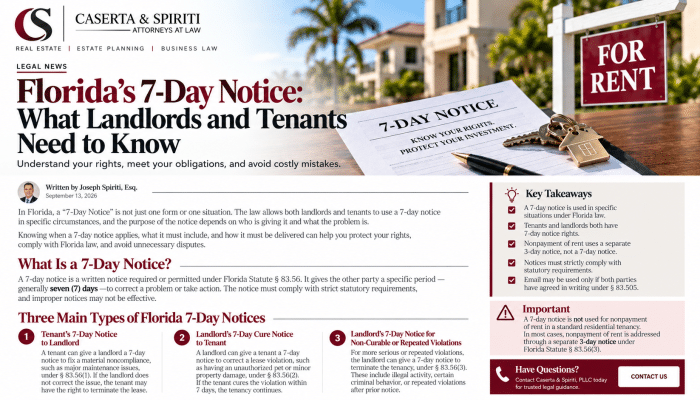

Month: September 2026

Florida’s 7-Day Notice: What Landlords and Tenants Need to Know

       [Understand your rights, meet your obligations, and avoid costly mistakes]

Written by Joseph Spiriti, Esq.

In Florida, a “7-Day Notice” is not one universal form. Depending on the problem, it can be used by a tenant against a landlord, by a landlord to give a tenant an opportunity to cure a lease violation, or by a landlord to terminate a tenancy for certain serious or repeated violations.

That distinction matters. Using the wrong notice, describing the violation poorly, or delivering the notice incorrectly can delay a case and weaken an otherwise valid position.

Key Takeaway
A Florida 7-Day Notice is not a one-size-fits-all document. The legal effect depends on who is giving it, why it is being given, and whether the violation is curable.

What Is a Florida 7-Day Notice?

Florida Statute § 83.56 governs several different notice situations in residential tenancies. The statute uses seven days in more than one context, but the legal effect changes depending on who is giving the notice and why.

The three most common 7-day situations are:

  1. A tenant gives notice to a landlord for material noncompliance.
  2. A landlord gives a tenant a 7-day opportunity to cure a curable violation.
  3. A landlord gives a tenant a 7-day notice for certain non-curable or repeated violations.

Tenant’s 7-Day Notice to the Landlord

Under § 83.56(1), if a landlord materially fails to comply with § 83.51(1) or a material provision of the rental agreement, the tenant may deliver written notice specifying the noncompliance and stating the tenant’s intention to terminate the rental agreement if the problem is not corrected within seven days.

This type of notice often comes up when there are serious repair or habitability issues. Florida law generally requires landlords to comply with applicable building, housing, and health codes and, where those codes do not apply, to maintain important structural components and plumbing in reasonable working condition.

The notice should be specific. A vague statement such as “the apartment is in bad condition” may not clearly identify what must be fixed.

Landlord’s 7-Day Cure Notice to the Tenant

Under § 83.56(2)(b), when a tenant materially violates § 83.52, a material term of the lease, or reasonable rules or regulations, and the violation is one the tenant should be given an opportunity to correct, the landlord may serve a written 7-day cure notice.

Examples listed in the statute include unauthorized pets, guests, or vehicles, unauthorized parking, and failing to keep the premises clean and sanitary.

The purpose of this notice is to tell the tenant exactly what the violation is and provide an opportunity to correct it within seven days.

If the same or similar conduct recurs within 12 months after the notice, the statute allows an eviction action to proceed without another opportunity to cure.

Landlord’s 7-Day Notice for Non-Curable or Repeated Violations

Some violations are treated more seriously.

Under § 83.56(2)(a), if the tenant’s noncompliance is of a nature that should not be given an opportunity to cure, or if the violation is a subsequent or continuing noncompliance within 12 months of a written warning for a similar violation, the landlord may serve notice terminating the rental agreement.

The statute gives examples such as intentional destruction, damage, or misuse of property, certain fraudulent entry conduct, and subsequent or continued unreasonable disturbances.

In that situation, the tenant has seven days from delivery of the notice to vacate.

Important: The 3-Day Rent Notice Is Different

A landlord generally does not use a 7-day notice for ordinary nonpayment of rent. Under § 83.56(3), nonpayment is handled through a separate 3-day notice procedure, excluding Saturdays, Sundays, and court-observed legal holidays.

How Must the Notice Be Delivered?

Section 83.56(4) provides that notices under subsections (1) through (3) may be delivered by mailing, delivering a true copy, e-mailing in accordance with § 83.505, or, if the tenant is absent, leaving a copy at the residence.

Email deserves special attention. Florida now permits electronic delivery of certain landlord-tenant notices, but only when the requirements of § 83.505 have been satisfied, including a signed addendum specifically agreeing to electronic delivery and valid email addresses for that purpose.

In other words, email is not automatically valid simply because the parties have communicated by email before.

Why the Language of the Notice Matters

A 7-day notice is more than a complaint letter. It may later become an important part of a court case.

The notice should identify the noncompliance clearly, state the appropriate statutory consequence, and avoid language inconsistent with the type of notice being used.

What Landlords Should Do Before Sending a Notice

Before serving a 7-day notice, a landlord should review the lease, confirm the facts, determine whether the violation is curable or non-curable, verify the correct delivery method, and consider whether there has been a prior written warning involving similar conduct within the preceding 12 months.

What Tenants Should Do Before Sending a Notice

Tenants should document the condition, preserve photographs and communications, review the lease, and clearly identify the landlord’s alleged noncompliance.

Where the issue involves repairs or maintenance, the analysis may depend on the type of property, the nature of the condition, and the landlord’s obligations under § 83.51.

Not every maintenance problem automatically gives a tenant the right to terminate a lease.

Getting the Notice Right the First Time

A Florida 7-Day Notice is not a one-size-fits-all document. The legal effect depends on who is giving the notice, what the alleged violation is, whether the violation is curable, whether a similar violation has occurred before, how the notice is written, and how it is delivered.

For landlords and tenants alike, getting the notice right at the beginning can make a significant difference later.

Caserta & Spiriti, PLLC assists landlords, tenants, property owners, and businesses with Florida real estate and landlord-tenant matters. If you have questions about a notice, lease violation, repair dispute, or potential eviction, obtaining legal guidance before taking action can help protect your rights and avoid costly procedural mistakes.

Disclaimer: This article is for general informational purposes only and is not legal advice. Reading this article does not create an attorney-client relationship. Florida landlord-tenant matters are fact-specific, and parties should consult qualified legal counsel regarding their particular circumstances.

Elder Law in Florida: Planning for Long-Term Care, Medicaid, Guardianship & Aging

As we age, legal and financial issues can become just as important as medical concerns. Florida Elder Law focuses on helping older adults and their families address issues such as long-term care, Medicaid planning, Estate Planning, Powers of Attorney, health care decisions, Guardianship, elder abuse, and financial exploitation.

The goal is not simply to plan for what happens after death. Elder law planning also addresses what happens if you need help managing your health, finances, or daily life while you are still living.

What Is Elder Law in Florida?

Elder Law is a broad area of legal practice involving issues that commonly affect seniors and their families. Depending on the circumstances, Elder Law planning may involve:

  • Wills and Trusts;
  • Durable Powers of Attorney;
  • Healthcare Surrogate Designations and Living Wills;
  • Long-term care planning;
  • Medicaid eligibility and planning;
  • Nursing home and assisted-living issues;
  • Guardianship and alternatives to Guardianship;
  • Asset protection planning;
  • Elder abuse and financial exploitation;
  • Veterans benefits;
  • Probate and estate administration; and
  • Planning for incapacity and changing care needs.

Because every family’s financial, medical, and family circumstances are different, there is no single Elder Law plan that works for everyone.

Why Is Long-Term Care Planning Important?

One of the most significant challenges facing older adults is paying for long-term care.

Long-term care may be provided at home, in an assisted-living setting, or in a nursing facility. It may include assistance with activities of daily living such as bathing, dressing, eating, and medication management.

A common misconception is that Medicare will pay for a person’s long-term nursing home care. Generally, it does not. Medicare may cover certain medically necessary, short-term skilled nursing facility services when specific requirements are satisfied, but it generally does not cover custodial long-term care simply because a person needs ongoing assistance with daily activities.

That distinction can have significant financial consequences.

Families should consider their potential sources of payment, which may include:

  • Personal income and assets;
  • Long-term care insurance;
  • Medicare for services it actually covers;
  • Medicaid, if eligibility requirements are satisfied;
  • Veterans benefits, when applicable; and
  • Other available public or private benefits.

Long-term care planning is generally more effective when it begins before a crisis occurs.

Medicare vs. Medicaid: What Is the Difference?

Medicare and Medicaid are different programs serving different purposes.

Medicare is federal health insurance primarily associated with people age 65 and older and certain individuals with disabilities. It can cover hospital care, physician services and certain skilled nursing or rehabilitation services.

Medicaid is a joint federal-state program that can provide health coverage to people who meet applicable financial and other eligibility requirements. Florida also has Medicaid programs specifically addressing long-term care.

For Florida’s Medicaid long-term care program, eligibility involves more than simply having limited income or assets. Among other requirements, an individual generally must meet applicable age or disability criteria and be determined through Florida’s assessment process to require the level of care specified by law.

Florida’s long-term care Medicaid program can cover services provided in nursing facilities as well as certain home and community-based services through the state’s managed-care system.

Because Medicaid eligibility rules can involve income, assets, transfers, marital status, medical needs and other factors, families should obtain individualized advice before transferring or giving away assets.

Can Medicaid Planning Protect Assets?

Potentially-but Medicaid planning must be done carefully.

Long-term care expenses can significantly affect a family’s financial security. Depending on the circumstances, advance planning may help a family understand whether assets can be preserved while still qualifying for benefits in the future.

However, there is no universal strategy that guarantees Medicaid eligibility or protects every asset.

Transactions involving gifts, transfers, Trusts, real estate, or other assets can have significant legal and Medicaid consequences. Planning should therefore be based on the individual’s circumstances and the applicable rules before assets are transferred, rather than after a nursing home crisis has already occurred.

What Estate Planning Documents Should Seniors Have?

A Florida estate plan should address more than the distribution of property at death.

Depending on the person’s circumstances, important documents may include:

Durable Power of Attorney. Allows an agent to handle financial and legal matters within the authority granted by the document.

Designation of Healthcare Surrogate. Identifies a person who may make health care decisions as authorized under Florida law when the individual cannot make those decisions.

Living Will. Expresses an individual’s wishes concerning life-prolonging procedures in circumstances covered by Florida law.

Last Will & Testament. Directs the disposition of property at death and can nominate individuals to serve in appropriate fiduciary roles.

Trust. In appropriate circumstances, a Trust may provide additional planning for asset management, incapacity, or distribution after death.

These documents should be coordinated rather than prepared in isolation. An estate plan that does not address incapacity may leave a family facing unnecessary difficulty when a person can no longer manage financial or health care decisions.

When Is Guardianship Necessary in Florida?

A Florida Guardianship may become necessary when an adult is unable to exercise some or all of his or her rights and existing planning documents or other less restrictive alternatives are inadequate.

Florida law provides procedures for determining incapacity and appointing a Guardian. Guardians have fiduciary responsibilities and may exercise only those rights that have been removed from the individual and delegated to the Guardian.

Guardianship is an important legal proceeding and should not automatically be viewed as the first solution.

Before pursuing Guardianship, families should determine whether an existing Durable Power of Attorney, Healthcare Designation, Trust, or another less restrictive planning arrangement can address the situation.

Planning while a person still has the legal capacity to make decisions can provide more options later.

What About Senior Housing and Assisted Living?

Aging does not necessarily mean moving into a nursing home.

Depending on a person’s health, finances and preferences, options may include:

  • Remaining at home with family or professional caregivers;
  • Home health or other supportive services;
  • Independent senior living;
  • Assisted living;
  • Memory-care communities;
  • Rehabilitation or skilled nursing facilities; or
  • Other community-based care arrangements.

The right choice depends on the individual’s care needs, safety, financial resources, and personal preferences.

Families should consider these issues before a medical crisis forces an immediate decision. A care manager, social worker, medical professional, or other qualified professional may also help a family evaluate practical care options.

Florida’s Department of Elderly Affairs administers and coordinates numerous programs and services for older Floridians, including long-term-care-related programs and the State Long-Term Care Ombudsman Program.

How Can Families Protect Against Elder Abuse and Financial Exploitation?

Elder Law also involves protecting vulnerable adults.

Florida law specifically addresses abuse, neglect and exploitation of elderly persons and disabled adults. Florida Statute § 825.103 addresses exploitation involving the improper use of an elderly person’s or disabled adult’s funds, assets, or property, including certain misconduct by persons in positions of trust and confidence and certain breaches of fiduciary duty by agents under Powers of Attorney, Guardians, and individual Trustees.

Warning signs can include:

  • Unexplained withdrawals or transfers;
  • Sudden changes to estate-planning documents;
  • Unusual financial gifts;
  • New or unexplained caregivers or “friends” controlling finances;
  • Missing property or valuables;
  • Isolation from family members; or
  • An agent, caregiver or family member refusing to provide financial information.

When exploitation or abuse is suspected, prompt action may be important. Depending on the circumstances, legal remedies, protective proceedings, or other interventions may be available.

When Should a Florida Family Talk to an Elder Law Attorney?

Families often wait until a parent enters a hospital or nursing facility before seeking legal advice. By then, some planning opportunities may be limited.

Consider obtaining legal advice when:

  • A parent is beginning to need significant assistance;
  • Nursing home or assisted-living care is being considered;
  • The family is concerned about how long-term care will be paid for;
  • Medicaid eligibility may become an issue;
  • A parent has significant assets that need to be reviewed;
  • Existing Estate Planning documents are outdated;
  • Someone is beginning to have difficulty managing finances or health care;
  • Family members disagree about care or finances;
  • Guardianship is being considered; or
  • Elder abuse or financial exploitation is suspected.

The earlier a family understands its options, the more opportunity there may be to make informed decisions.

Frequently Asked Questions About Florida Elder Law

What does an Elder Law attorney do in Florida?

An Elder Law attorney helps individuals and families address legal issues associated with aging, including Estate Planning, incapacity planning, long-term care planning, Medicaid, Guardianship, and protection against exploitation.

Does Medicare pay for nursing home care in Florida?

Medicare may cover certain short-term skilled nursing facility services when its requirements are met, but it generally does not pay for ongoing custodial long-term nursing home care.

Does Medicaid pay for nursing home care in Florida?

Florida Medicaid can provide long-term care services to individuals who satisfy applicable eligibility and care requirements. Eligibility should be evaluated on an individual basis.

Can I protect my home from nursing home costs?

The answer depends on the circumstances, including how the property is owned, whether it qualifies as homestead, the individual’s marital and family situation, and applicable Medicaid rules. Do not transfer your home or other assets solely to qualify for Medicaid without first obtaining appropriate legal advice.

Is Guardianship always necessary if a person becomes incapacitated?

No. Florida law recognizes Guardianship as a legal process, but existing Powers of Attorney, health care documents, Trusts, and other arrangements may provide alternatives or reduce the need for court involvement in appropriate circumstances.

Planning for Aging Is About More Than Estate Distribution

Elder law planning is not simply about deciding who receives your property after you die. It is also about planning for the years before death, including who can make decisions, where care will be provided, how that care may be paid for, and how family members can protect a loved one’s dignity and financial interests.

At Caserta & Spiriti, PLLC in Miami Lakes, Florida, we assist individuals and families with Florida estate planning, long-term care planning, Medicaid-related planning, powers of attorney, guardianship matters and other legal issues affecting seniors and their families.

If you or a loved one is beginning to face questions about long-term care, Medicaid, incapacity, guardianship or aging in Florida, obtaining legal advice before a crisis may help you better understand the available options.

Disclaimer: This article is provided for general informational and educational purposes only and is not intended to constitute legal advice. It does not create an attorney-client relationship. Medicaid, Medicare, Guardianship, and long-term care rules are fact-specific and subject to change. The information in this article should not be relied upon as a substitute for advice concerning your particular circumstances.

What Is a Living Will in Florida and Why Should You Have One?

[A Florida Living Will Can Help Make Your Healthcare Wishes Clear When You Cannot Speak for Yourself]

When most people hear the words “Living Will,” they think of a Last Will & Testament. The two documents serve very different purposes.

A Last Will & Testament generally addresses the distribution of property after death. A Florida Living Will is an Advance Healthcare Directive that addresses your wishes concerning certain life-prolonging procedures while you are still alive but unable to make or communicate healthcare decisions for yourself.

For many Florida adults, a Living Will is an important part of a comprehensive estate plan.

What Is a Living Will in Florida?

Under Florida law, a competent adult may make a Living Will directing the provision, withholding, or withdrawal of life-prolonging procedures if the person has a terminal condition, an end-stage condition, or is in a persistent vegetative state, as those terms are addressed by Florida law.

A Living Will can communicate your wishes concerning difficult medical decisions when you cannot speak for yourself.

Circumstances can include:

  • A serious or terminal illness;
  • A catastrophic accident;
  • A persistent vegetative state;
  • An end-stage medical condition; or
  • Other circumstances in which you are incapacitated and the statutory requirements for implementing the Living Will are satisfied.

Florida law requires a Living Will to be signed by the Principal in the presence of two witnesses, at least one of whom is neither the Principal’s spouse nor blood relative.

Why Is a Living Will Important?

Without clear instructions, family members may be left trying to determine what you would have wanted during an emotionally difficult medical crisis.

A properly prepared Living Will can:

  • Communicate your wishes;
  • Provide guidance to your loved ones and healthcare providers;
  • Reduce uncertainty concerning certain life-prolonging treatment decisions; and
  • Help avoid disagreements about what you would have wanted.

Florida law provides that a properly executed Living Will creates a rebuttable presumption of clear and convincing evidence of the Principal’s wishes.

A Living Will Is Not the Same as a Healthcare Surrogate

These documents work together but serve different purposes.

A Living Will communicates your wishes concerning life-prolonging procedures in the circumstances addressed by Florida law.

A Designation of Healthcare Surrogate allows you to appoint a trusted person to make health- care decisions on your behalf when you are unable to make them yourself. Florida law requires a written designation to be signed in the presence of two adult witnesses, with at least one witness being neither the Principal’s spouse nor blood relative.

Having both documents can provide your family and healthcare providers with clearer guidance.

What Happens If You Do Not Have a Living Will?

Not having a Living Will does not necessarily mean that no one can make healthcare decisions for you.

Florida law provides a statutory framework for healthcare decision-making when an individual has not executed an applicable Advance Directive or when a designated surrogate is unavailable. Depending on the circumstances, decision-making authority may fall to a spouse, adult children, parent, adult siblings, certain other relatives, a close friend, or another person identified by statute.

However, relying on the statutory default does not necessarily mean that the person making the decision will know what you would have wanted.

That is why advance planning matters.

Tell Your Healthcare Surrogate What You Want

Preparing the documents is only part of the process.

Talk with the person you designate as your Healthcare Surrogate about your values and preferences. Explain what matters to you and how you would want difficult medical decisions approached.

Keep copies of your documents where they can be found and make sure your surrogate and appropriate healthcare providers know that the documents exist. Florida law specifically places responsibility on the Principal to provide notice to the primary physician that a Living Will has been made.

Review Your Advance Directives

Estate planning documents should be reviewed when circumstances change. Consider reviewing your Living Will and other Advance Directives after:

  • Marriage or divorce;
  • Death or incapacity of your designated surrogate;
  • A significant change in your health;
  • A major change in family circumstances;
  • Moving to or from Florida; or
  • A change in your personal healthcare wishes.

Florida law also addresses amendment and revocation of Advance Directives, so an attorney can help ensure that an updated plan properly reflects your current wishes.

Include Your Living Will in Your Florida Estate Plan

A complete estate plan is about more than distributing property after death. It should also address what happens if you become incapacitated during your lifetime.

Depending upon your circumstances, a Florida estate plan may include a:

  • Last Will & Testament;
  • Revocable Living Trust;
  • Durable Power of Attorney;
  • Designation of Healthcare Surrogate;
  • Living Will;
  • HIPAA authorization; and
  • Other documents appropriate to your circumstances.

At Caserta & Spiriti, PLLC, in Miami Lakes, we help Florida individuals and families coordinate their estate planning and Advance Healthcare Directives, so their legal documents reflect their wishes and work together as part of an overall plan.

Planning ahead gives you the opportunity to make important decisions while you are able to make them and gives your family clearer guidance when they may need it most.

Disclaimer: This article is provided for general informational and educational purposes only and is not intended to constitute legal advice. Reading this article does not create an attorney-client relationship. Florida law and individual circumstances vary. You should consult a qualified Florida attorney regarding your particular estate planning and healthcare needs.