
Month: November 2026

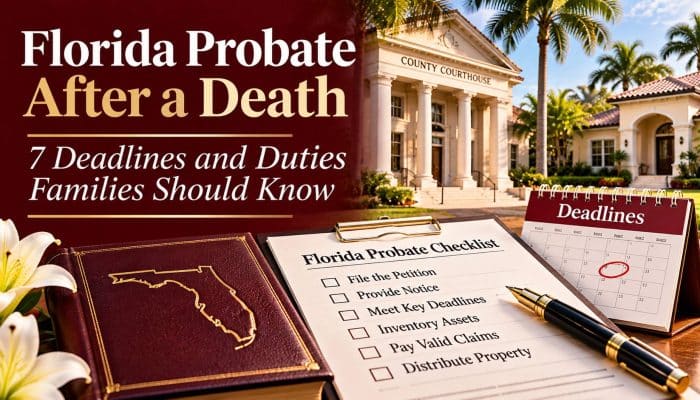
Florida Probate After a Death

CSG FLORIDA LEGAL AUTHORITY

7 Deadlines and Duties Families Should Know

Written by Robert Mellinger, Esq.

After a family member dies, Florida probate can feel like a maze of paperwork and deadlines at exactly the time a family is least prepared to deal with them. Some deadlines begin with the death itself. Others begin only after a notice is served, a probate case is opened, or a Notice To Creditors is published or a creditor receives notice.

The most important practical lesson is simple: do not assume that “nothing needs to be done yet.” Florida law imposes duties on the custodian of a Will, gives beneficiaries and creditors limited periods to act, and places fiduciary obligations on the personal representative once appointed.

KEY TAKEAWAY

Florida probate does not have one universal deadline. Different rights run from different triggering events. The original Will generally must be deposited within 10 days after the custodian learns of the death; objections after a Notice of Administration have their own limits; exempt-property rights can be waived if not timely asserted; creditor claims are subject to separate statutory bars; and the personal representative has an ongoing fiduciary duty to administer the estate efficiently and in the best interests of interested persons.

1. The Original Will: The 10-Day Rule

One of the earliest Florida probate duties can arise before a probate case is even opened. Under Florida Statute § 732.901, the custodian of a Will must deposit the Will with the clerk of the court having venue of the decedent’s estate within 10 days after receiving information that the testator is dead.

The custodian must also supply the testator’s date of death or the last four digits of the testator’s Social Security number to the clerk when depositing the Will. If the custodian fails to deposit the Will without just or reasonable cause, a court may compel production and may assess costs, damages, and a reasonable attorney’s fee against the delinquent custodian.

For families, this means the original Will should be located promptly. A photocopy stored on a phone or computer is not a substitute for locating the original instrument when one exists.

2. Opening Probate: Who Can Start the Case?

Florida Statute § 733.202 provides that any interested person may petition for administration. The person named as personal representative in the Will often takes the lead, but the statute is not limited to that person.

Opening probate is more than filing a document. The court must determine whether a Will should be admitted, whether the proposed personal representative is qualified, and what notices and administration procedures are required. A self-proved Will may generally be admitted without additional proof under § 733.201, while other circumstances can require witness testimony or other proof.

3. Notice of Administration Can Start Important Objection Deadlines

Once a formal administration is underway, the Notice of Administration can trigger significant deadlines. Section 733.212 addresses service of the notice and the time for certain objections involving the validity of the Will, venue, and jurisdiction.

The current statute contains strict limitations and expressly states that certain periods may not be extended for reasons such as affirmative representation, failure to disclose information, or misconduct. Depending on the particular objection and circumstances, additional statutory outside limits may also apply.

A beneficiary who receives a Notice of Administration should therefore read it immediately rather than putting it aside with routine estate correspondence.

4. Exempt Property Has Its Own Deadline

Florida law protects certain categories of property for qualifying family members, but those rights are not necessarily self-executing forever. Section 733.212 states that persons who may be entitled to exempt property under § 732.402 can be deemed to have waived those rights unless a petition for determination of exempt property is timely filed.

The general deadline stated in the Notice of Administration statute is the later of four months after service of the Notice of Administration on the person or 40 days after termination of specified proceedings involving the Will or other matters affecting the exempt property.

This is a good example of why families should not treat all probate assets alike. Homestead, exempt property, family allowance, probate assets, and nonprobate transfers can involve different rules.

5. Creditors Have a Separate Claims Process

Creditor claims are governed primarily by Part VII of Chapter 733. The personal representative must address Notice to Creditors, claims, objections, priority, and payment under the applicable statutes.

Florida probate creditor law includes both shorter claim periods associated with publication or service of notice and an outside statutory bar. Whether a particular claim is timely can depend on the creditor, the type of claim, whether proper notice was given, and other statutory exceptions.

For that reason, a personal representative should not simply pay whichever bills arrive first. Claims must be evaluated within the statutory administration process, and distributions to beneficiaries should be coordinated with valid estate obligations.

6. The Personal Representative Is a Fiduciary, Not Merely a Family Organizer

Once appointed, the personal representative assumes legal duties. Section 733.602 provides that a personal representative is a fiduciary and must observe standards of care applicable to trustees. The personal representative has a duty to settle and distribute the estate according to the Will and the Probate Code as expeditiously and efficiently as is consistent with the estate’s best interests.

The statute also directs the personal representative to use the authority granted by the Probate Code, the Will, and court orders for the best interests of interested persons, including creditors.

Practically, this means the personal representative should safeguard estate property, maintain records, identify assets and liabilities, coordinate required notices, avoid self-dealing, and refrain from premature distributions that could leave the estate unable to satisfy valid obligations.

7. Do Not Distribute the Estate Too Early

Families understandably want to transfer vehicles, close accounts, divide personal property, sell real estate, or distribute cash soon after a death. But probate administration is not simply a race to divide assets.

The personal representative must consider creditor rights, taxes, expenses of administration, protected family rights, the terms of the Will, court orders, and the interests of beneficiaries. A distribution that seems harmless can create problems if a valid claim or statutory right later must be satisfied.

Before substantial distributions are made, the personal representative should understand what assets are actually part of the probate estate, which obligations remain unresolved, and whether court approval or additional administration steps are required.

What About Property That Does Not Pass Through Probate?

Not every asset owned or controlled by a decedent necessarily becomes a probate asset. Property may pass by survivorship, beneficiary designation, trust, or another nonprobate mechanism. Florida homestead can also have special constitutional and statutory treatment.

That makes the first asset inventory especially important. Families should identify how each asset is titled and whether a beneficiary or survivorship arrangement exists before assuming that the Will controls it.

What If the Original Will Cannot Be Found?

A lost or destroyed Will can create a different probate problem. Florida Statute § 733.207 provides a procedure for establishing and admitting a lost or destroyed Will, but the evidentiary requirements are different from simply presenting the original document.

Families who find copies but cannot locate the original should avoid making assumptions about validity and should obtain legal advice before treating the estate as intestate.

A Practical First-30-Days Checklist

In the first weeks after a death, families should consider locating the original Will and estate-planning documents; obtaining certified death certificates; identifying the current deed to any Florida real estate; securing the residence and other property; identifying bank, investment, retirement, insurance, and business accounts; determining whether accounts have beneficiaries or survivorship features; gathering bills and creditor correspondence; preserving financial records; identifying the person nominated as personal representative; and obtaining probate advice before transferring or distributing substantial assets.

Where a surviving spouse, minor child, homestead, blended family, business interest, disputed Will, creditor issue, or substantial real estate is involved, early review is particularly important because additional statutory rights and deadlines may apply.

Why Families Get Into Trouble

Many probate problems do not begin with bad intentions. They begin with assumptions: “Mom’s Will says I get the house, so I can sell it;” “Dad owed that credit card, so I should pay it from my own account;” “We are all the children, so we can divide everything ourselves;” or “There is no hurry because probate can wait.”

Florida law may produce a different answer depending on title, homestead status, the Will, family relationships, creditor rights, and the type of asset involved. The safest approach is to identify the legal framework before irreversible steps are taken.

The Bottom Line

Florida probate is manageable when the family understands the sequence of events and treats deadlines seriously. The original Will should be addressed promptly. Notices should be read immediately. Creditor and beneficiary rights should be evaluated before distributions are made. And the personal representative should understand that the role carries fiduciary responsibilities, not merely administrative convenience.

At Caserta & Spiriti, PLLC, we assist Florida families with probate administration, elder law, estate planning, homestead issues, deeds, and related real estate matters. Early guidance can help families preserve rights, avoid missed deadlines, and move the estate toward an orderly resolution.

Disclaimer: This article is provided for general informational and educational purposes only and is not legal advice. Reading this article or receiving this e-mail does not create an attorney-client relationship. Probate rights and deadlines are fact-specific and may depend on the type of proceeding, the notice served, the family circumstances, the assets involved, and other facts.
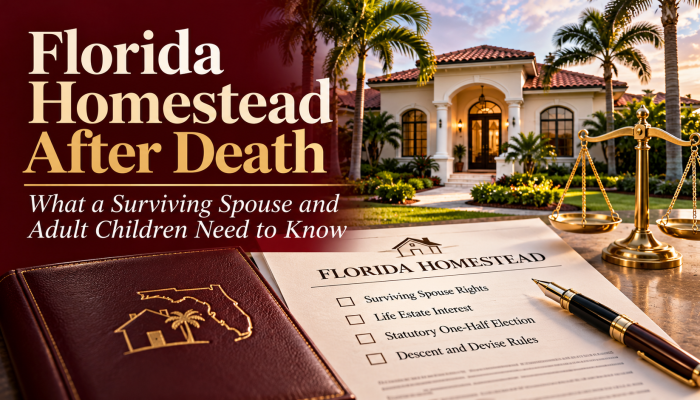

Florida Homestead After Death

What a Surviving Spouse and Adult Children Need to Know

Written by Robert Mellinger, Esq.

Florida homestead law can produce results that surprise families after a homeowner dies. A Will may say one thing, a deed may suggest another, and family members may assume that a surviving spouse automatically becomes the sole owner of the home. Florida law, however, gives homestead property special constitutional and statutory treatment.

When a Florida homeowner dies leaving a surviving spouse, descendants, or both, the first questions should include whether the property was the decedent’s protected homestead, how title was held, whether the homestead was validly devised, and whether a surviving spouse has an election that must be exercised within a statutory deadline.

KEY TAKEAWAY

A Florida Will does not necessarily control homestead the same way it controls ordinary probate property. If homestead is not devised as Florida law and the Constitution permit, and the decedent leaves a spouse and descendants, the surviving spouse generally receives a life estate and the descendants receive the vested remainder. The spouse may instead elect an undivided one-half interest as a tenant in common-but the election generally must be made within six months after death and during the spouse’s lifetime.

Why Florida Homestead Is Different

Florida’s homestead protections are not merely tax rules. Homestead can affect creditor protection, restrictions on devise, and the ownership interests that arise at death. Chapter 732 of the 2026 Florida Statutes contains specific rules governing descent and devise of protected homestead.

That is why an estate plan should not analyze the Last Will & Testament in isolation. The deed, marital status, descendants, constitutional homestead status, Trusts, and other ownership arrangements can all matter.

When a Homestead Cannot Be Freely Devised

Florida Statute § 732.4015 reflects the constitutional restriction on devise. If the owner is survived by a spouse or minor child, the homestead is not freely devisable, except that the homestead may be devised to the owner’s spouse when there is no minor child.

The statute also recognizes that a disposition through certain Trusts can constitute a “devise” for homestead purposes. Moving a residence into a Trust therefore does not automatically eliminate Florida’s homestead restrictions.

What Happens When the Decedent Leaves a Spouse and Descendants?

Under § 732.401, when protected homestead is not devised as authorized by law and the Constitution, and the decedent is survived by a spouse and one or more descendants, the surviving spouse takes a life estate in the homestead. The decedent’s descendants in being at death receive the vested remainder per stirpes.

A life estate and a remainder interest divide ownership over time. The surviving spouse has the present life estate interest, while the descendants hold the future remainder. That structure can create practical questions involving possession, repairs, insurance, taxes, improvements, sale, and allocation of expenses.

The Surviving Spouse Has an Important Alternative

Florida law gives the surviving spouse an alternative to the statutory life estate. Instead of taking the life estate, the spouse may elect an undivided one-half interest in the homestead as a tenant in common. The remaining undivided one-half interest then vests in the decedent’s descendants in being at death, per stirpes.

This can materially change the family’s ownership structure. A life tenant and remaindermen have different rights and economic interests from co-owners holding undivided tenant-in-common interests.

The Six-Month Deadline Is Critical

The homestead election is time-sensitive. Section 732.401 provides that the election generally must be made within six months after the decedent’s death and during the surviving spouse’s lifetime. Once made, the election is irrevocable.

The statute requires the election to be made by recording a notice of election containing the legal description of the homestead in the official records of the county or counties where the property is located. Special rules apply when an attorney in fact or guardian seeks court approval to make the election for the surviving spouse.

Families should therefore obtain advice promptly after death rather than waiting until the probate estate is close to completion.

How Are Property Expenses Handled?

Until a one-half tenant-in-common election is made, § 732.401 directs that expenses relating to ownership of the homestead be allocated between the surviving spouse as life tenant and the descendants as remaindermen under Chapter 738. If the spouse makes the election, ownership expenses are allocated between the spouse and descendants as tenants in common in proportion to their shares, effective as of the filing of the election.

This is one reason families should avoid informal assumptions about who “owns the house” or who must pay every expense after death.

Title Can Change the Analysis

Section 732.401 expressly does not apply to property the decedent owned in tenancy by the entireties or in joint tenancy with rights of survivorship. Those forms of ownership can carry survivorship consequences independent of the descent rule discussed above.

The exact deed should therefore be reviewed before anyone concludes that the residence must pass through the homestead descent framework.

Homestead and the Elective Share Are Separate Concepts

Florida also protects a surviving spouse through the elective-share statutes. Under § 732.2065, the elective share is 30 percent of the elective estate. The elective estate can include more than the traditional probate estate; § 732.2035 identifies categories that can enter into the elective-estate calculation, including the decedent’s interest in protected homestead.

At the same time, § 732.2105 provides that the elective share is in addition to homestead, exempt property, and statutory allowances. These provisions are technical and should not be reduced to the assumption that a spouse simply receives “30 percent of probate.”

Elective-Share Deadlines Also Matter

The elective share has its own deadline structure. Section 732.2135 generally requires the election to be filed by the earlier of six months after service of the notice of administration on the surviving spouse (or the specified representative) or two years after the decedent’s death, subject to the statute’s provisions concerning extensions and related proceedings.

This deadline is distinct from the six-month homestead election under § 732.401. A surviving spouse may therefore have multiple rights requiring separate analysis and separate action.

What If There Is No Valid Homestead Devise?

If homestead is not devised as authorized, the statutory descent rules apply. The consequences depend on who survives the decedent and how title was held. Where a spouse and descendants survive, the life estate/remainder structure and the spouse’s one-half election become central.

Where the family structure is different, the result can be different. This is why a deed, Will, Trust, marital history, and family tree should be reviewed together.

Adult Children Should Not Assume They Can Force Immediate Control

When descendants receive vested remainder interests subject to a surviving spouse’s life estate, their ownership interest is real, but it is not the same as the spouse’s present possessory life estate interest. Conversely, a surviving spouse should not assume that a life estate is equivalent to sole fee-simple ownership.

When the spouse elects a one-half tenant-in-common interest, the legal relationship changes again. Families considering sale, refinancing, major repairs, or settlement should identify the actual interests before signing documents or making commitments.

Estate Planning Before Death Can Prevent Confusion

Homestead planning is especially important in second marriages, blended families, families with minor children, and situations where the homeowner wants a spouse to remain in the residence while ultimately preserving an interest for descendants.

A Will, Trust, deed, beneficiary plan, marital agreement, and Power of Attorney should be coordinated rather than drafted as unrelated documents. A plan that appears straightforward for ordinary assets may operate very differently when the asset is Florida protected homestead.

Practical Checklist After a Florida Homeowner Dies

Before deciding who owns the residence or how it should be handled, obtain and review the current deed; determine whether the property qualified as the decedent’s homestead; identify the surviving spouse and descendants, including whether any child is a minor; review the Will and any relevant Trust; determine whether the property was held with survivorship rights; calendar the surviving spouse’s six-month homestead election deadline when applicable; evaluate any elective-share rights and deadlines separately; and avoid selling, transferring, or encumbering the property until the ownership interests are understood.

The Bottom Line

Florida homestead is one of the areas where a seemingly simple estate can become legally complicated very quickly. The home may be subject to constitutional restrictions on devise, statutory descent rules, a surviving spouse’s election, and separate elective-share rights.

For surviving spouses and adult children, early analysis can prevent missed deadlines and misunderstandings about ownership. For homeowners planning ahead, coordinating the deed and estate-planning documents can reduce the risk of an unintended result.

At Caserta & Spiriti, PLLC, we assist Florida families with elder law, probate, estate planning, deeds, homestead issues, and related real estate matters.

Disclaimer: This article is provided for general informational and educational purposes only and is not legal advice. Reading this article or receiving this e-mail does not create an attorney-client relationship. Florida homestead and probate rights are highly fact-specific and may depend on the deed, family circumstances, estate-planning documents, and timing.

Florida legal email notices article illustration

Florida Landlord-Tenant Notices by Email

CSG FLORIDA LEGAL AUTHORITY

What Florida Statute § 83.505 Means in 2026

Written by Joseph Spiriti, Esq.

Florida residential landlords and tenants can now use e-mail for notices required by Florida’s Residential Landlord and Tenant Act—but only when the statutory requirements are satisfied. Florida Statute § 83.505 does not simply say that an ordinary e-mail is always good enough. It creates a voluntary framework that depends on a signed rental-agreement addendum, designated e-mail addresses, recordkeeping, and rules governing delivery, revocation, and address changes.

For decades, Florida landlord-tenant practice has been built around formal notice requirements. A notice may start or preserve an important legal deadline, and the method of delivery can become just as important as the words in the notice.

Effective July 1, 2025, Florida law added a significant modern option. Section 83.505 allows a landlord or tenant to electronically deliver by e-mail notices required under Part II of Chapter 83 when the parties have properly elected electronic delivery. The change can make residential leasing more efficient, but it also creates a new compliance question: when does an e-mail actually qualify as statutory delivery?

KEY TAKEAWAY

E-mail is not automatically a substitute for every traditional delivery method. To use § 83.505, the parties must sign an addendum specifically agreeing to electronic delivery, each must provide a valid e-mail address, and the addendum must conspicuously explain that the election is voluntary and may be revoked or updated. A compliant e-mail notice is generally deemed delivered when sent unless it is returned as undeliverable.

A Text Message or Ordinary E-mail Habit Is Not the Statutory Election

Many landlords and tenants already communicate by e-mail, text message, resident portals, or property-management applications. That history should not be confused with the statutory election. Section 83.505 requires the parties to sign an addendum to the rental agreement specifically agreeing to electronic delivery of notices and to provide valid designated e-mail addresses. The addendum must conspicuously advise both sides that the election is voluntary and may later be revoked or the address updated.

The Election Is Voluntary

Neither side is required by § 83.505 to agree to electronic delivery. The statutory form expressly provides an opportunity to agree or decline. If the statutory arrangement is not in place, the parties should continue using delivery methods otherwise authorized by the applicable law.

When Is an E-mailed Notice Delivered?

A notice electronically delivered in accordance with § 83.505 is deemed delivered at the time it is sent unless the e-mail is returned to the sender as undeliverable. Because Chapter 83 contains time-sensitive notices, the date and time of transmission can become important evidence.

The Sender Has a Recordkeeping Duty

The statute requires the sender to maintain a copy of the electronically sent notice and evidence of transmission. A sound property-management procedure should preserve the actual notice, designated recipient address, transmission date and time, and evidence showing that it was sent.

What If the E-mail Bounces?

The delivered-when-sent rule does not apply if the e-mail is returned as undeliverable. Landlords and tenants relying on electronic statutory notice should therefore monitor the sending account and act promptly when a message is rejected or returned.

Changing the Designated E-mail Address

A party may update the designated e-mail address at any time by providing written notice to the other party specifying the new address. The update takes effect upon delivery of that written notice. Accurate records are therefore essential.

Revoking Consent

A party may revoke the agreement to electronic delivery at any time by written notice to the other party. Revocation becomes effective upon delivery and does not invalidate notices properly sent electronically before the revocation became effective.

Security Deposits Show Why the Details Matter

Section 83.49 now recognizes e-mail in accordance with § 83.505 for specified security-deposit notices. If a landlord does not intend to impose a claim on a residential security deposit, the deposit generally must be returned with any required interest within 15 days after termination. If the landlord intends to impose a claim, the required notice generally must be provided within 30 days after termination. Current law permits that notice by certified mail or by e-mail in accordance with § 83.505. The tenant generally has 15 days after receipt to object in writing.

Because these deadlines affect important rights, a defective electronic-delivery procedure can create litigation over whether notice was valid and when it was delivered.

E-mail Does Not Eliminate Other Permitted Methods

Section 83.505 expressly states that it does not preclude service of notices by other means permitted by law. Electronic delivery is an option, not an exclusive system. The safest method depends on the particular notice, statute, lease, parties’ elections, and circumstances.

Practical Checklist for Florida Landlords

Before relying on e-mail, confirm the parties signed a § 83.505 addendum substantially following the statutory form; both sides provided valid designated addresses; the election has not been revoked; no later written notice changed the address; the underlying notice itself satisfies Chapter 83; the message goes to the correct address; the notice and transmission evidence are preserved; and the sending account is monitored for an undeliverable return.

Practical Checklist for Florida Tenants

A designated e-mail address can become the destination for time-sensitive legal notices. Tenants should use an account they monitor regularly, maintain access, promptly provide written notice of any address change, and retain evidence of any revocation. Tenants sending statutory notices electronically should preserve the notice and transmission evidence as well.

Why This Change Matters in 2026

Chapter 2025-16, Laws of Florida, which created § 83.505, took effect July 1, 2025. By 2026, landlords, tenants, lawyers, and property managers should be incorporating the electronic-notice option into current forms and procedures rather than relying on older assumptions about Chapter 83.

The change is convenient, but convenience should not be confused with informality. The Legislature created a structured system with a prescribed election, designated addresses, revocation rights, an undeliverable-message exception, and recordkeeping requirements.

The Bottom Line

Florida law now gives residential landlords and tenants a useful option for delivering notices by e-mail. When properly implemented, § 83.505 can reduce delays and create a clear electronic record. But the parties need the proper signed addendum and designated addresses, consent remains voluntary and revocable, the sender must preserve the notice and transmission evidence, and an e-mail returned as undeliverable does not receive the statute’s delivered-when-sent treatment.

At Caserta & Spiriti, PLLC, we assist Florida landlords, tenants, property owners, and businesses with lease preparation and review, statutory notices, security-deposit disputes, evictions, real estate contracts, and related property matters.

Disclaimer: This article is provided for general informational and educational purposes only and is not legal advice. Reading this article or receiving this e-mail does not create an attorney-client relationship. Florida landlord-tenant rights are fact-specific.