
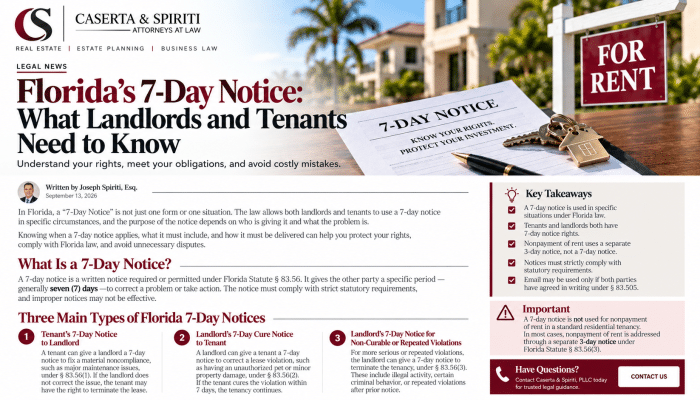
[Understand your rights, meet your obligations, and avoid costly mistakes]
Written by Joseph Spiriti, Esq.
In Florida, a “7-Day Notice” is not one universal form. Depending on the problem, it can be used by a tenant against a landlord, by a landlord to give a tenant an opportunity to cure a lease violation, or by a landlord to terminate a tenancy for certain serious or repeated violations.
That distinction matters. Using the wrong notice, describing the violation poorly, or delivering the notice incorrectly can delay a case and weaken an otherwise valid position.
Key Takeaway
A Florida 7-Day Notice is not a one-size-fits-all document. The legal effect depends on who is giving it, why it is being given, and whether the violation is curable.
What Is a Florida 7-Day Notice?
Florida Statute § 83.56 governs several different notice situations in residential tenancies. The statute uses seven days in more than one context, but the legal effect changes depending on who is giving the notice and why.
The three most common 7-day situations are:
- A tenant gives notice to a landlord for material noncompliance.
- A landlord gives a tenant a 7-day opportunity to cure a curable violation.
- A landlord gives a tenant a 7-day notice for certain non-curable or repeated violations.
Tenant’s 7-Day Notice to the Landlord
Under § 83.56(1), if a landlord materially fails to comply with § 83.51(1) or a material provision of the rental agreement, the tenant may deliver written notice specifying the noncompliance and stating the tenant’s intention to terminate the rental agreement if the problem is not corrected within seven days.
This type of notice often comes up when there are serious repair or habitability issues. Florida law generally requires landlords to comply with applicable building, housing, and health codes and, where those codes do not apply, to maintain important structural components and plumbing in reasonable working condition.
The notice should be specific. A vague statement such as “the apartment is in bad condition” may not clearly identify what must be fixed.
Landlord’s 7-Day Cure Notice to the Tenant
Under § 83.56(2)(b), when a tenant materially violates § 83.52, a material term of the lease, or reasonable rules or regulations, and the violation is one the tenant should be given an opportunity to correct, the landlord may serve a written 7-day cure notice.
Examples listed in the statute include unauthorized pets, guests, or vehicles, unauthorized parking, and failing to keep the premises clean and sanitary.
The purpose of this notice is to tell the tenant exactly what the violation is and provide an opportunity to correct it within seven days.
If the same or similar conduct recurs within 12 months after the notice, the statute allows an eviction action to proceed without another opportunity to cure.
Landlord’s 7-Day Notice for Non-Curable or Repeated Violations
Some violations are treated more seriously.
Under § 83.56(2)(a), if the tenant’s noncompliance is of a nature that should not be given an opportunity to cure, or if the violation is a subsequent or continuing noncompliance within 12 months of a written warning for a similar violation, the landlord may serve notice terminating the rental agreement.
The statute gives examples such as intentional destruction, damage, or misuse of property, certain fraudulent entry conduct, and subsequent or continued unreasonable disturbances.
In that situation, the tenant has seven days from delivery of the notice to vacate.
Important: The 3-Day Rent Notice Is Different
A landlord generally does not use a 7-day notice for ordinary nonpayment of rent. Under § 83.56(3), nonpayment is handled through a separate 3-day notice procedure, excluding Saturdays, Sundays, and court-observed legal holidays.
How Must the Notice Be Delivered?
Section 83.56(4) provides that notices under subsections (1) through (3) may be delivered by mailing, delivering a true copy, e-mailing in accordance with § 83.505, or, if the tenant is absent, leaving a copy at the residence.
Email deserves special attention. Florida now permits electronic delivery of certain landlord-tenant notices, but only when the requirements of § 83.505 have been satisfied, including a signed addendum specifically agreeing to electronic delivery and valid email addresses for that purpose.
In other words, email is not automatically valid simply because the parties have communicated by email before.
Why the Language of the Notice Matters
A 7-day notice is more than a complaint letter. It may later become an important part of a court case.
The notice should identify the noncompliance clearly, state the appropriate statutory consequence, and avoid language inconsistent with the type of notice being used.
What Landlords Should Do Before Sending a Notice
Before serving a 7-day notice, a landlord should review the lease, confirm the facts, determine whether the violation is curable or non-curable, verify the correct delivery method, and consider whether there has been a prior written warning involving similar conduct within the preceding 12 months.
What Tenants Should Do Before Sending a Notice
Tenants should document the condition, preserve photographs and communications, review the lease, and clearly identify the landlord’s alleged noncompliance.
Where the issue involves repairs or maintenance, the analysis may depend on the type of property, the nature of the condition, and the landlord’s obligations under § 83.51.
Not every maintenance problem automatically gives a tenant the right to terminate a lease.
Getting the Notice Right the First Time
A Florida 7-Day Notice is not a one-size-fits-all document. The legal effect depends on who is giving the notice, what the alleged violation is, whether the violation is curable, whether a similar violation has occurred before, how the notice is written, and how it is delivered.
For landlords and tenants alike, getting the notice right at the beginning can make a significant difference later.
Caserta & Spiriti, PLLC assists landlords, tenants, property owners, and businesses with Florida real estate and landlord-tenant matters. If you have questions about a notice, lease violation, repair dispute, or potential eviction, obtaining legal guidance before taking action can help protect your rights and avoid costly procedural mistakes.
Disclaimer: This article is for general informational purposes only and is not legal advice. Reading this article does not create an attorney-client relationship. Florida landlord-tenant matters are fact-specific, and parties should consult qualified legal counsel regarding their particular circumstances.